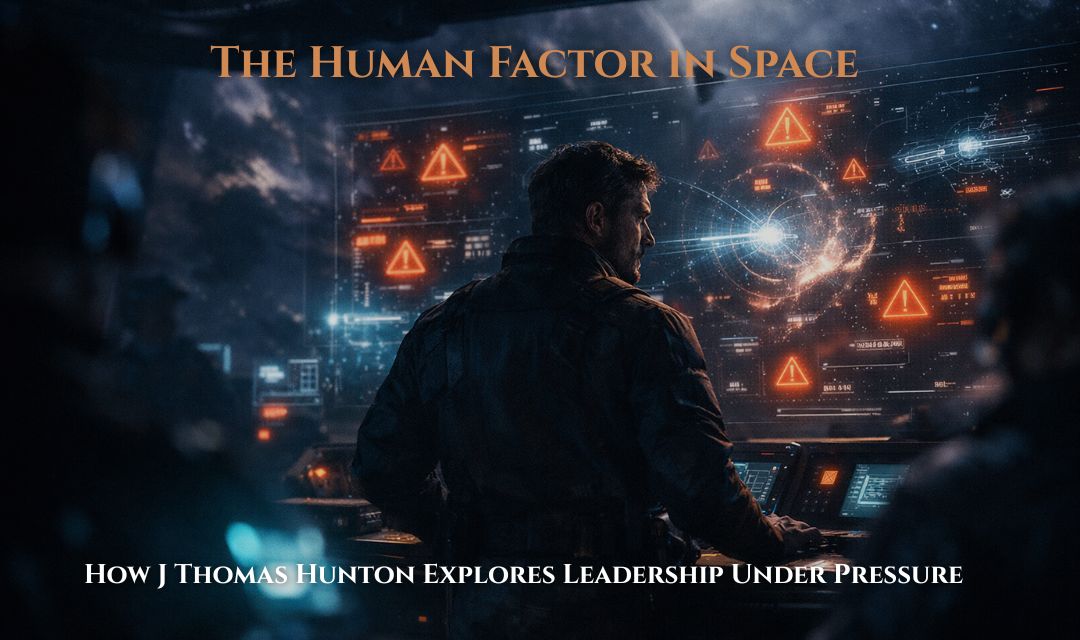
Science fiction often focuses on technology, discovery, and the vastness of space but at its core, the most compelling stories are driven by human decisions. J Thomas Hunton’s work stands out for its deep exploration of leadership, responsibility, and human behavior when placed under extreme conditions.
In his narratives, survival is not determined solely by advanced systems or cutting-edge spacecraft. It is shaped by the choices people make when those systems begin to fail.
Leadership Beyond Control
In the controlled environment of Earth, leadership follows structure and predictability. In space, those rules quickly begin to break down. J Thomas Hunton places his characters in situations where command is tested not by routine operations, but by crisis.
Mission leaders are forced to operate with incomplete information, limited resources, and escalating risks. Orders must be given, but certainty is rarely available. This creates a dynamic where leadership becomes less about authority and more about judgment under pressure.
Decision Making in Uncertainty
One of the defining aspects of Hunton’s storytelling is his focus on decision-making in moments where no option is clearly right. Whether facing a system failure, a time anomaly, or an unknown external threat, characters must act without fully understanding the consequences.
This uncertainty adds depth to the narrative. Every decision carries weight, and the outcome is often irreversible. The tension does not come from what might happen it comes from knowing that something will happen, and it may not be survivable.
The Conflict Between Protocol and Survival
Military structure and discipline play a central role in Hunton’s work. Chains of command, procedures, and mission objectives provide stability until they no longer apply.
When conditions change beyond expectation, characters are forced to choose between following protocol and adapting to survive. This conflict creates powerful moments where leadership is redefined, and rules are tested against reality.
Hunton uses these situations to explore a critical question: when everything is at risk, is it more dangerous to break the rules or to follow them?
Trust, Isolation, and Human Limits
In deep space, trust becomes one of the most valuable resources. Crews must rely on each other not only for operational success, but for emotional stability. Isolation amplifies tension, and small fractures in trust can escalate into major risks.
J Thomas Hunton captures this dynamic by showing how individuals respond differently under pressure. Some rise to the challenge, while others struggle with doubt, fear, or conflicting priorities. These human elements make his stories feel grounded, even within extraordinary environments.
Why Human-Centered Sci-Fi Resonates
Modern readers are increasingly drawn to science fiction Displacement that balances technology with human experience. J Thomas Hunton’s work reflects this shift, offering stories that are not just about space exploration, but about the people who undertake it.
By focusing on leadership, decision making, and human resilience, his writing creates a deeper connection with readers. The challenges may be cosmic in scale, but the emotions and choices remain deeply human.
A Story of More Than Survival
At its core, J Thomas Hunton’s science fiction is not just about surviving the unknown it is about understanding what it means to lead, to decide, and to endure when control is no longer possible. For readers seeking science fiction that explores both the vastness of space and the complexity of human nature, his work offers a compelling and thought-provoking experience.