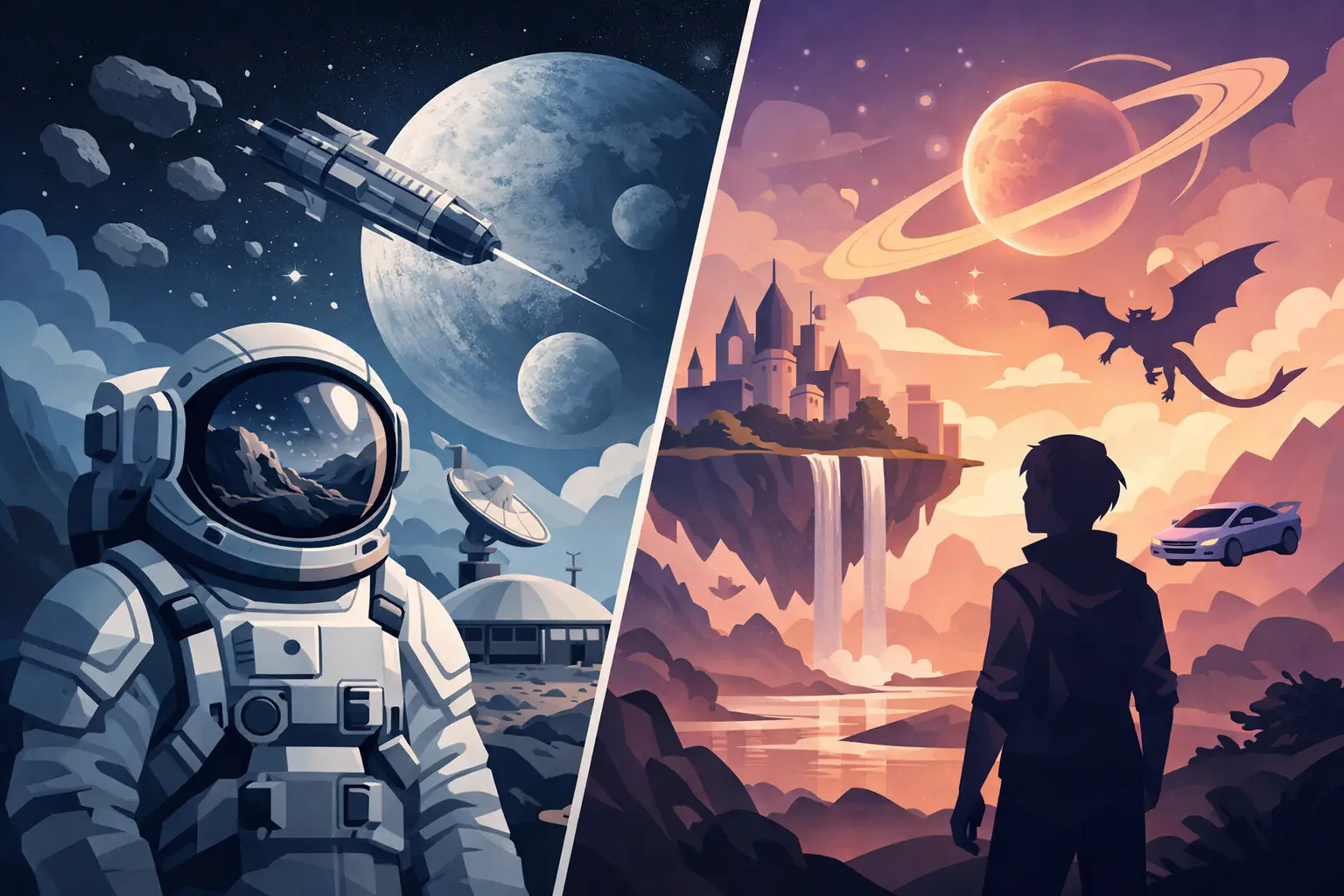
A wormhole opens near Mars. A traveler returns from a mission to find that forty years have passed on Earth. An alien signal reveals a pattern no human mind can fully interpret. The question in hard sci-fi vs speculative fiction is not whether these ideas belong on the page. It is what the story asks them to do.
For readers drawn to the intersection of time, space, and humanity, the distinction matters because it shapes the experience of wonder. One story may make you study orbital mechanics, causality, and the brutal arithmetic of survival. Another may begin with the same stars and use them to expose a civilization’s fears, a family’s loyalties, or the moral cost of becoming something other than human.
The categories overlap constantly. The most memorable science fiction often lives in that overlap. But understanding the difference reveals why some novels feel like an expedition into the unknown while others feel like a thought experiment aimed directly at the human condition.
Hard Sci-Fi vs Speculative Fiction: The Core Difference
Hard science fiction is defined less by the presence of advanced technology than by the discipline behind it. It tries to honor known science, or to extend it with careful logic. Physics is not scenery. It is an active force in the plot, capable of limiting a mission, separating characters across light-years, or turning a brilliant solution into a devastating trade-off.
Speculative fiction is the wider territory. It includes science fiction, but also stories that use altered histories, future societies, fantasy elements, dystopias, supernatural premises, or impossible technologies to ask, “What if?” Its central commitment is not necessarily to scientific accuracy. Its commitment is to meaningful consequences.
That does not make speculative fiction less serious. Quite the opposite. A speculative novel may invent a premise that current science cannot support and still examine power, memory, identity, faith, violence, or love with extraordinary precision. Its rules simply answer to the story’s thematic purpose before they answer to a textbook.
A hard sci-fi novel might ask how a colony can survive when radiation, fuel, food, gravity, and communication delays are all nonnegotiable. A speculative novel might ask what happens to personhood when consciousness can be copied, edited, sold, or placed in a new body. Either question can produce a thrilling novel. Their engines are different.
In Hard Sci-Fi, Reality Pushes Back
The defining pleasure of hard science fiction is resistance. Space is vast. Energy is expensive. Time is not a neutral container that characters can step in and out of without consequence. A spacecraft cannot accelerate forever because the author needs a faster chase scene. A planet cannot become a second Earth just because the setting would be more convenient.
That resistance creates stakes with unusual force. When a crew must choose between diverting power to life support or maintaining a return trajectory, the tension comes from more than danger. It comes from the sense that the universe has rules, and those rules will not negotiate.
Scientific rigor can take many forms. It may mean plausible engineering, careful astronomy, evolutionary biology, information theory, or a sustained engagement with relativity. It does not require pages of equations. The best hard sci-fi makes technical constraints intelligible because they matter emotionally. A delay in communication becomes a marriage strained across planets. Relativistic time becomes a daughter aging beyond recognition while her parent remains young aboard a ship.
Even time travel, wormholes, and parallel timelines can belong in hard sci-fi when the story takes their implications seriously. The premise may be speculative, but the consequences must be earned. If changing the past creates branching realities, what does that mean for responsibility? If a wormhole links two distant points, who controls it, and what happens when its stability depends on choices no one can reverse?
Hard science fiction does not promise that every theory will someday be proven correct. It promises intellectual honesty. It asks readers to believe that the author has considered the cost of the impossible.
Speculative Fiction Begins Where Certainty Ends
Speculative fiction has room for science that bends, breaks, or has not yet been discovered. Its freedom is immense. A future society may be built around a single radical invention. An alternate timeline may hinge on one historical divergence. An alien intelligence may communicate through dreams, music, or a form of perception that makes human language inadequate.
The key is consistency. Readers will accept almost any premise if the narrative understands its own rules and follows the human consequences wherever they lead. A machine that predicts death need not be technologically plausible to be dramatically potent. But the story must decide who has access to it, how people react to its predictions, and what it costs to know.
This is why speculative fiction can be so unsettling. It takes a familiar structure of life and shifts one element just far enough that everything else becomes visible. Change reproduction, memory, labor, mortality, climate, or surveillance, and ordinary assumptions begin to fracture.
The genre’s broadness is a strength, not a weakness. It gives writers permission to build impossible worlds in order to tell the truth about this one. Yet that breadth can also hide a difference in reader expectations. Someone seeking a meticulously rendered Mars mission may be disappointed by a novel where Mars is primarily a symbolic frontier. Someone seeking a fierce meditation on consciousness may not want every chapter paused for propulsion calculations.
Neither preference is wrong. They point to different kinds of imaginative hunger.
The Boundary Is More Porous Than It Looks
Hard sci-fi and speculative fiction are not opposing teams. Hard sci-fi is usually speculative fiction. The disagreement begins only when labels are treated as verdicts on quality or ambition.
A novel can be scientifically rigorous and emotionally thin. It may construct an astonishingly plausible habitat, then fill it with characters who feel like delivery systems for exposition. Another novel can take enormous liberties with physics and still leave readers haunted by its moral vision. Accuracy alone does not create depth, and imaginative boldness does not excuse careless storytelling.
The strongest works often combine the virtues of both. They use scientific thought as a source of pressure, not decoration, while recognizing that the real drama emerges in human response. A failed terraforming project is never just a failed project if it forces a community to decide who receives oxygen. A parallel timeline is never just a clever device if it confronts a character with the life they abandoned.
That fusion is especially powerful in stories of exploration. The unknown is not compelling merely because it is far away. It matters because discovery changes the discoverer. A signal from another intelligence can alter political systems, religious beliefs, and the private meaning of being human. A journey beyond the solar system can become a confrontation with isolation, grief, ambition, and the burden of carrying Earth’s old conflicts into a new sky.
How to Tell Which Kind of Story You Want Next
Ask what you want the impossible element to deliver. If you want to feel the weight of a mission plan, the limitations of human bodies, and the astonishing difficulty of reaching another world, hard sci-fi is likely your destination. Look for stories where scientific constraints shape every major decision and where solutions create new problems rather than erasing them.
If you want a premise that destabilizes your assumptions about society or selfhood, speculative fiction may offer the wider field. Look for stories that use an altered reality to investigate consequences that feel uncomfortably close to home.
Then leave room for surprise. A scientifically grounded story can be deeply philosophical. A wildly improbable premise can be executed with rigorous internal logic. Some readers want the technical detail; others want the existential shock. Many want both, especially when a story has the confidence to make cosmic scale feel personal.
J. Thomas Hunton’s fiction occupies that charged territory where scientific imagination meets human consequence. Time, distance, alien intelligence, and fractured timelines are not decorative concepts. They are pressures placed on characters who must live with choices that may reach across worlds and centuries.
Why the Distinction Matters to Serious Sci-Fi Readers
Genre labels help readers find a doorway, but they should never become a locked gate. Calling a novel hard sci-fi signals that the universe will have teeth. Calling it speculative fiction signals that the story may push beyond established knowledge to test an idea with unusual reach.
For a reader, that distinction can guide expectations. For a writer, it can clarify responsibility. The harder the science, the more carefully the story must honor material constraints. The broader the speculation, the more carefully it must honor emotional and thematic consequences. In either case, the goal is not to prove that the author is clever. It is to make the reader feel that the impossible has become inevitable.
The next time a story offers you a new planet, a break in causality, or a voice from beyond human understanding, ask a better question than whether it is hard sci-fi or speculative fiction. Ask what that impossible thing demands from the people who encounter it. That is where scientific wonder becomes drama, and where the future starts to feel dangerously real.
2 Responses
https://shorturl.fm/4VYuX