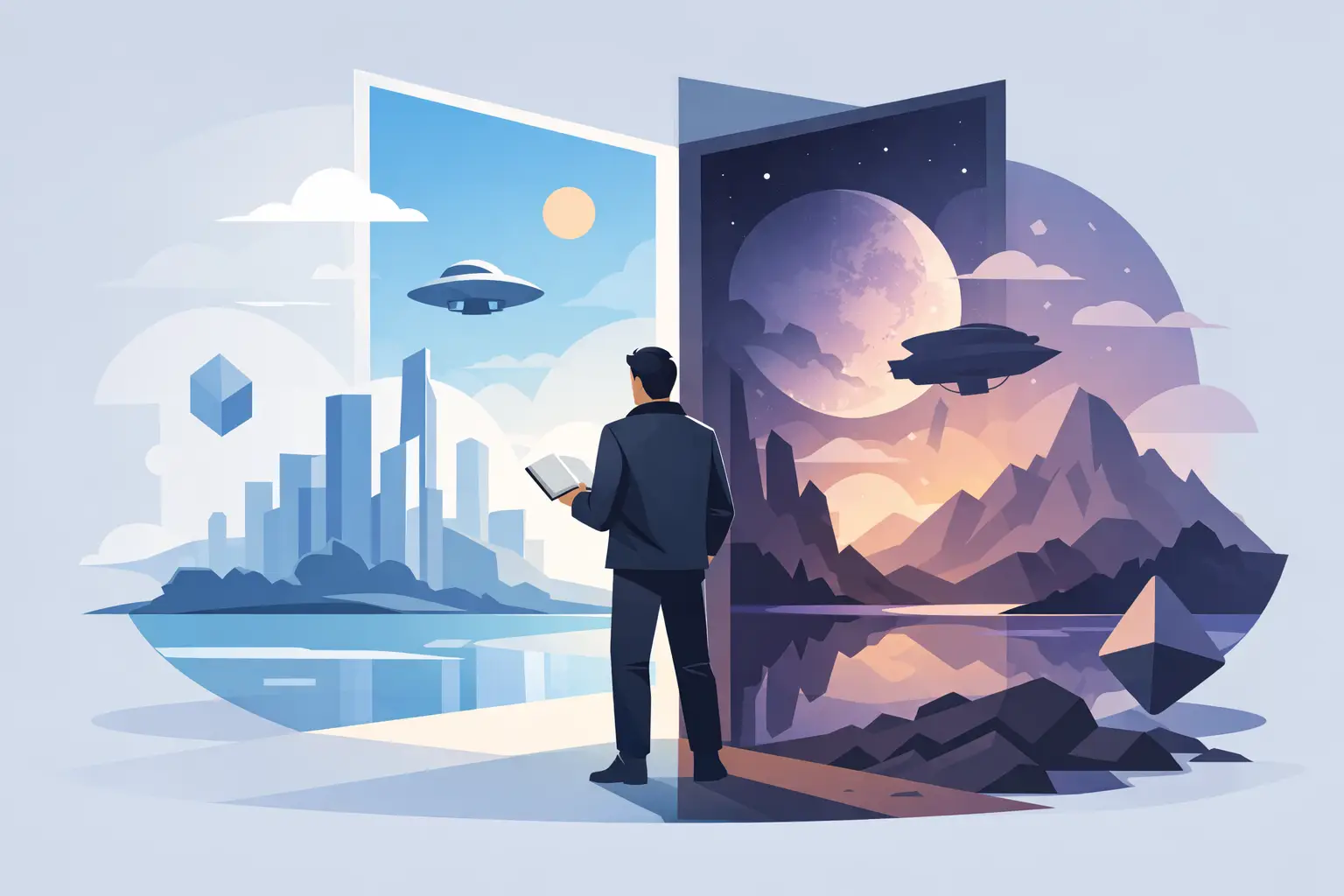
Some novels ask what if history had bent a different way. Better alternate reality novels ask a harsher question: if reality can split, fracture, or be rewritten, what happens to the people forced to live inside the break? That is the real territory of a guide to alternate reality novels – not just strange worlds, but the collision between physics, choice, memory, and consequence.
For serious science fiction readers, alternate reality fiction is one of the genre’s most fertile frontiers. It can carry the intellectual force of theoretical physics, the pressure of political speculation, and the emotional devastation of lives that might have been. Done well, it is not a gimmick. It is a lens that exposes how fragile identity becomes when the universe no longer agrees on a single version of truth.
What this guide to alternate reality novels is really about
Alternate reality novels are often grouped together too loosely. Readers hear the phrase and think of parallel universes, changed timelines, or simple historical divergence as if they were interchangeable. They are related, but they do different work on the page.
An alternate history novel usually begins with a clear point of divergence. A war ends differently. A political movement survives. A scientific breakthrough arrives decades early. The fascination comes from causality. Readers trace how one altered event ripples across culture, technology, and power.
Parallel world fiction is wider and stranger. Instead of one timeline altered from a known past, it presents multiple coexisting realities. Some are nearly identical. Others are radically transformed by environmental, biological, or technological shifts. The tension comes from contrast. Characters may move between realities, glimpse alternate selves, or confront worlds shaped by decisions they never made.
Time travel fiction often overlaps with both, but its center of gravity is different. The drama rests on intervention. Characters act within time and discover that every attempt to preserve, repair, or control reality creates new fractures. In the strongest novels, time is not a toy. It is a force with moral consequences.
If you love hard science fiction, this distinction matters. A strong alternate reality novel does more than swap scenery. It builds rules. It asks whether the branching universe follows quantum logic, temporal mechanics, simulation theory, or something more metaphysical. The explanation does not need to become a textbook, but it must feel coherent enough that the stakes carry weight.
Why alternate reality novels hit so hard
At their best, these stories reach the intersection of time, space, and humanity. They let writers stage enormous conceptual drama while keeping the emotional field intensely personal. A battle between civilizations is compelling. A conversation between someone and the version of themselves who made a different choice can be devastating.
That is why the subgenre has such a hold on readers who want more than surface spectacle. Alternate realities make consequence visible. Regret becomes architecture. Political systems become experiments. Love, grief, ambition, and guilt stop being private feelings and become world-shaping variables.
There is also a deeper philosophical pull. If many versions of reality are possible, what gives this one meaning? Is identity something stable, or only a pattern repeated under pressure? If another version of your life exists somewhere beyond the veil, are your sacrifices still sacred? The best novels do not hand you neat answers. They intensify the questions.
The elements that separate great books from clever premises
A lot of speculative fiction has a strong setup and a weak follow-through. Alternate reality novels are especially vulnerable to this because the idea itself can sound dazzling in a pitch. A world where Rome never fell. A moon colony founded in 1890. A timeline where first contact happened during the Cold War. The concept can carry attention for a few chapters. It cannot carry a novel by itself.
What matters first is internal logic. Readers will accept extraordinary conditions if the story respects cause and effect. If crossing realities is possible, there should be constraints, costs, or consequences. If history diverged, the resulting society should feel shaped by that divergence in economics, language, technology, and daily life. The more ambitious the premise, the more discipline the worldbuilding requires.
Character depth matters just as much. This is where many books either become unforgettable or collapse into abstraction. A novel may contain brilliant speculation, but if nobody within it feels morally alive, the alternate reality remains distant. The strongest stories place fully human characters inside destabilized worlds and force them to choose between incompatible truths.
Pacing is another dividing line. Some alternate reality novels thrive on cerebral density. Others move with thriller speed. Neither approach is automatically superior. It depends on what the book is trying to do. But there is always a trade-off. Dense conceptual work can create awe and seriousness, yet it risks slowing momentum. Fast plotting can intensify urgency, yet it may flatten the philosophical dimensions. The rare novel does both.
How to choose the right alternate reality novel for you
The smartest way to approach this subgenre is to follow the kind of tension you want.
If you are drawn to historical speculation, look for books rooted in a precise divergence point. These tend to reward readers who enjoy politics, military strategy, and large-scale cultural consequences. They are ideal when you want to see history treated as a machine that can be recalibrated.
If your interest leans toward identity and existential unease, choose novels centered on parallel selves or neighboring worlds. These stories often feel more intimate, even when the scope is cosmic. They are less about changing a historical event and more about confronting the unstable boundaries of selfhood.
If you want scientific intensity, seek novels that ground alternate realities in quantum theory, causality loops, relativistic time, or advanced cosmology. Here the pleasure comes from intellectual rigor. The ideas are not decorative. They shape every decision and every cost.
And if emotional stakes matter most, watch for stories where the speculative framework magnifies a human fracture already present – grief, estrangement, obsession, guilt, or impossible love. The alternate reality should heighten the wound, not distract from it.
A reader’s guide to alternate reality novels in science fiction
Science fiction gives alternate reality fiction its most explosive possibilities because it asks not only what changed, but how change can be measured, engineered, survived, or weaponized. A political alternate world may unsettle the mind. A scientifically grounded one can unsettle your sense of the universe itself.
That is where serious readers often become selective. They want the speculation to feel earned. They want the technology, temporal theory, or cosmological model to create pressure rather than jargon. Hard sci-fi readers in particular tend to reject stories that gesture toward infinite realities without wrestling with implication. If every choice creates a new universe, then travel, communication, and intervention should alter ethics as much as plot.
The finest books understand this. They recognize that alternate realities are not merely settings but systems of consequence. If one timeline can be sacrificed to save another, who decides which lives count? If knowledge from another reality can accelerate science, can it also destabilize civilization? If memory persists across realities, is that a gift, a contamination, or a sentence?
This is the territory where speculative fiction becomes genuinely dramatic. It stops asking whether something extraordinary can happen and starts asking what it costs when it does.
Common disappointments in the subgenre
Readers looking for the best alternate reality novels should be aware of a few recurring traps. One is the novelty trap, where the altered world is imaginative but emotionally inert. Another is the exposition trap, where the novel explains its mechanics so relentlessly that wonder dies on the page.
There is also the false-depth problem. Some books borrow the language of quantum possibility or timeline fracture without doing the harder work of philosophical or scientific consistency. They sound intelligent for a while. Then the structure reveals itself as decorative smoke.
That does not mean every novel needs equations in the margins. It means the story must respect its own implications. Even a more literary or surreal alternate reality novel needs conviction. The universe may be unstable, but the author’s intent cannot be.
Why this subgenre keeps mattering
Alternate reality fiction continues to endure because it speaks to something painfully recognizable. Most people know what it is to imagine a different life built from one changed decision. Science fiction magnifies that instinct to a cosmic scale. It turns private counterfactuals into entire worlds.
That is why the subgenre can feel so urgent. It mirrors the way history itself often seems suspended on tiny hinges – one vote, one mission, one discovery, one act of fear, one act of courage. In visionary hands, alternate reality novels remind us that possibility is never abstract. It shapes nations, families, and inner lives with equal force.
For readers who want science fiction with intellectual architecture and emotional gravity, this is not a side corridor of the genre. It is one of its grand proving grounds. And when you find the right novel, the effect is unforgettable: not just the thrill of seeing another world, but the shock of realizing how unstable your own has always been.
If you are choosing your next read, choose the book that treats alternate reality as more than spectacle. Choose the one that understands every broken timeline still contains a human heartbeat.
2 Responses