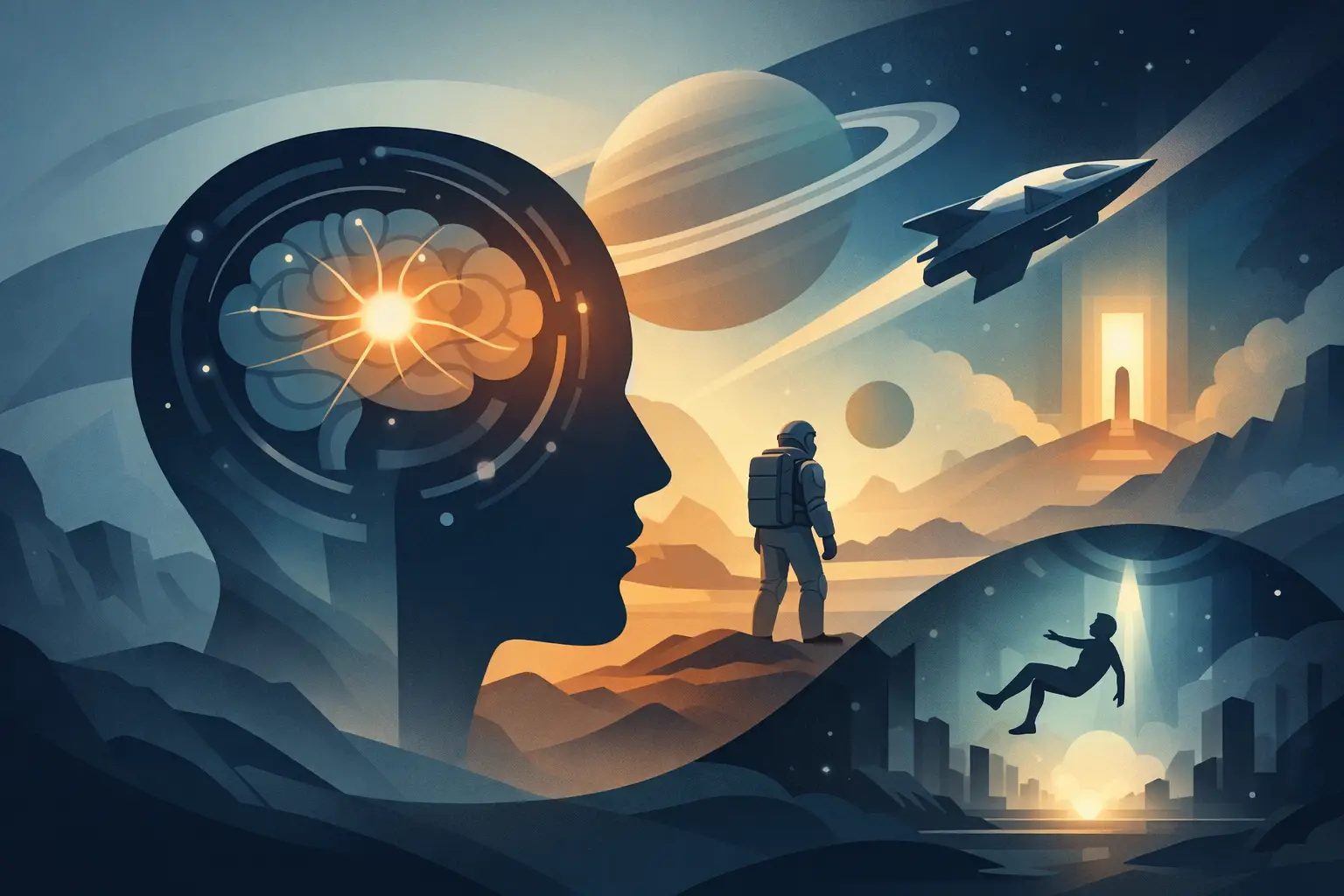
Some science fiction gives you starships, weapons, and scale. The stories that stay with you do something more unsettling. The best examples of psychologically intense sci fi turn the speculative lens inward, forcing characters to confront fractured memory, unstable identity, isolation, obsession, and the terrible cost of knowing too much.
That is where the genre becomes truly dangerous. When advanced technology, alien contact, time distortion, or cosmic distance stop being background decoration and start acting as pressure systems on the human mind, science fiction gains a different kind of gravity. It becomes less about what humanity can build and more about what humanity can endure.
What makes examples of psychologically intense sci fi work?
Psychological intensity in science fiction is not just darkness, and it is not just high stakes. Plenty of bleak stories never cut deep because the internal conflict is thin. What gives this kind of sci fi its force is the collision between a vast speculative idea and a very intimate human fracture.
Sometimes that fracture is memory. Sometimes it is guilt, paranoia, grief, or the fear that consciousness itself can be altered, copied, trapped, or erased. Hard science concepts often sharpen the effect rather than soften it. If time travel scrambles causality, if AI mirrors human behavior too well, or if interstellar travel isolates a crew beyond any hope of rescue, the psychological consequences become impossible to ignore.
The strongest stories also resist easy answers. They leave room for ambiguity. Was the threat external, or did it emerge from within? Did the character discover truth, or simply lose the ability to tell truth from delusion? That uncertainty is part of the charge.
10 examples of psychologically intense sci fi
1. Solaris by Stanislaw Lem
Few novels understand alien contact as profoundly as Solaris. The planet is not terrifying because it attacks in familiar ways. It is terrifying because it reaches into memory and grief, then gives them form. The scientists orbiting Solaris are not simply studying an intelligence. They are being studied, exposed, and psychologically dismantled.
The novel works because it refuses the comfort of easy communication. Lem makes first contact feel uncanny, humiliating, and deeply personal. The real battlefield is not the station. It is the human mind confronting something immeasurably beyond its categories.
2. Blindsight by Peter Watts
If sci fi can wound your sense of human exceptionalism, Blindsight is a clean strike to the chest. Its central question is brutal – what if consciousness is not an advantage? What if self-awareness is a costly evolutionary glitch rather than the crown of intelligence?
The psychological intensity comes from more than dread. It comes from the steady erosion of assumptions about identity, agency, and what it means to be sentient. Watts combines hard science, altered cognition, and first contact into a story that feels clinically precise and existentially merciless.
3. The Left Hand of Darkness by Ursula K. Le Guin
This novel is often discussed for its treatment of gender, but its psychological power runs even deeper. Genly Ai is not just navigating a foreign world. He is confronting the limits of his own social conditioning and the emotional isolation that follows from misunderstanding others at the most fundamental level.
Le Guin builds intensity through estrangement rather than spectacle. Trust is fragile. Identity is unstable. The emotional temperature rises not through combat, but through the slow recognition that another culture can expose how incomplete your own mind has been.
4. Annihilation by Jeff VanderMeer
Strictly speaking, this leans into speculative weird fiction, but for readers searching for psychologically intense sci fi, it belongs in the conversation. The biologist at the center of Annihilation enters Area X as part of an expedition, yet the mission quickly becomes secondary to perception itself.
The novel excels at making the mind feel porous. Observation changes the observer. The landscape seems to rewrite language, motive, and selfhood. You are never fully certain whether the terror lies in the environment, the narrator, or the act of trying to separate the two.
5. Ubik by Philip K. Dick
Dick remains one of the great architects of psychological destabilization in science fiction. Ubik is a masterclass in reality slippage. Death, commercial technology, psychic intrusion, and decaying timelines all collapse into a story where nothing stays fixed long enough to trust.
What makes it intense is not confusion for its own sake. Dick understood that reality failure is frightening because the self depends on continuity. Once time, causality, and physical law begin to wobble, identity follows. Ubik makes paranoia feel metaphysical.
6. Never Let Me Go by Kazuo Ishiguro
This is science fiction at its quietest and most devastating. The speculative premise is restrained, almost hidden at first, yet the emotional effect is enormous. Ishiguro focuses on memory, deferred knowledge, and the unbearable civility of systems built on dehumanization.
There are no grand battles here. That is exactly why it hurts. The psychological force comes from what the characters slowly understand about their lives, their futures, and the ways people adapt to monstrous structures when those structures are presented as normal.
7. The Three Stigmata of Palmer Eldritch by Philip K. Dick
If Ubik destabilizes reality, this novel contaminates it. Drugs, religion, consumer culture, and invasive consciousness bleed together until the characters can no longer tell whether they are acting freely or being occupied by something larger and more malignant.
Dick turns altered perception into spiritual horror. The result is not just a mind-bending story but a deeply unnerving one, where the self becomes contested territory. It is psychologically intense in the purest sense – a struggle over who, or what, gets to live inside your awareness.
8. Hyperion by Dan Simmons
Hyperion is expansive, but within that scale are several deeply psychological narratives. The priest’s tale and the scholar’s tale in particular carry extraordinary emotional pressure. Faith, time distortion, bodily transformation, and irreversible loss are not treated as abstract concepts. They are lived through in intimate, devastating ways.
The novel proves that psychological sci fi does not have to be claustrophobic. It can be epic in scope while still cutting close to the nerve. Simmons understands that cosmic grandeur becomes more powerful when filtered through grief and obsession.
9. The Gone World by Tom Sweterlitsch
This novel takes time travel and treats it as contamination. Investigating a murder opens into a reality of branching futures, existential dread, and the knowledge of an approaching end. The protagonist is not simply solving a case. She is carrying the cognitive and emotional burden of multiple possible worlds.
What makes the book hit so hard is its refusal to separate procedural logic from psychic damage. Knowledge does not clarify. It corrodes. The more the future is seen, the less stable the present becomes.
10. Moon by Duncan Jones
Though it is a film rather than a novel, Moon deserves a place here because it captures a central truth of psychologically intense science fiction: isolation can become a technology of erasure. The lunar setting is spare, controlled, and hauntingly plausible. The science fiction premise lands because it is inseparable from loneliness and identity collapse.
The film is especially effective for readers and viewers who prefer intimate stakes over military spectacle. It asks a simple but devastating question – if your life has been engineered, what remains of the self you thought was uniquely yours?
Why these stories resonate with serious sci fi readers
Readers drawn to hard science fiction often want more than elegant concepts. They want consequence. They want the machinery of time, space, intelligence, and physics to press against moral choice and emotional survival. That is why these examples endure.
Psychologically intense sci fi respects the mind as part of the frontier. It understands that the encounter with alien intelligence, nonlinear time, synthetic consciousness, or deep space isolation should not leave people unchanged. If anything, a story that treats such forces lightly can feel less believable than one that follows them into trauma, obsession, or philosophical rupture.
There is, of course, a trade-off. Some readers want velocity, tactical conflict, and external action. These books and films often move differently. They ask for patience. They favor pressure over explosion. But for readers who want speculative fiction with real interior stakes, that slower burn can feel far more explosive than another battle scene.
If you are looking for more examples of psychologically intense sci fi
Start by asking what kind of intensity you want. Some stories attack certainty and reality. Others focus on grief, identity, or the cost of knowledge. Some are rigorous and clinical. Others are dreamlike and disorienting. The subgenre is broader than it first appears, which is part of its power.
For readers who like science fiction at the intersection of time, space, and humanity, this territory remains one of the genre’s richest frontiers. It is where bold concepts stop being decorative and start becoming personal. J. Thomas Hunton’s kind of reader will recognize the appeal immediately – the mind under pressure, the cosmos pushing back, and every answer opening into a deeper human question.
The most memorable science fiction does not merely imagine other worlds. It forces us to face what happens to the human mind when those worlds finally answer back.
One Response