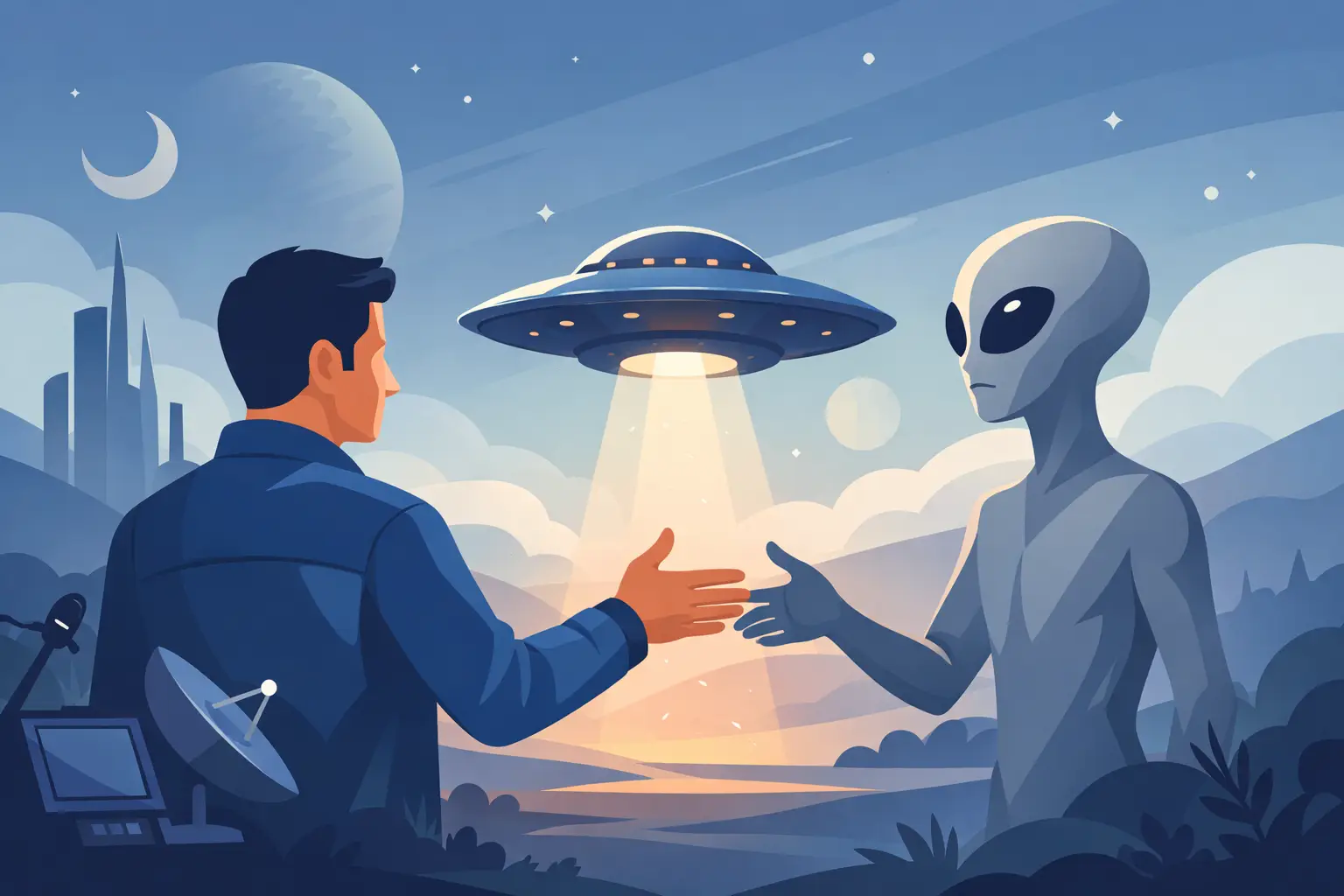
The opening of a first-contact story lives or dies in a single moment: the instant someone realizes the universe is no longer empty. If you want to learn how to start first-contact fiction, start there – not with a lecture, not with a galaxy-spanning history lesson, but with the precise fracture in human certainty when the unknown answers back.
First contact is one of science fiction’s most powerful promises because it forces two immensities into collision. One is cosmic scale: distance, time, biology, language, physics. The other is intensely human scale: fear, pride, curiosity, grief, faith, ambition. A weak opening treats alien contact as a plot event. A strong opening treats it as a civilizational wound, a revelation, or a test.
That means your first pages should not merely announce that aliens exist. They should establish what that fact costs.
What makes first-contact fiction different
A first-contact novel is not just an alien invasion story, and it is not automatically an exploration story either. Its center of gravity is encounter. The drama comes from interpretation before it comes from combat. What was seen? What does it mean? Who gets to speak for humanity? What if the signal is real but cannot be understood? What if understanding it changes us more than the beings who sent it?
This is where many drafts lose force. Writers often rush to spectacle – the ship in orbit, the artifact on the moon, the impossible message buried in background radiation. Spectacle matters, but only if it arrives attached to consequence. An object is interesting. A response to an object is story.
So when you decide how to begin, ask a more dangerous question than “What happens first?” Ask, “What assumption about reality breaks first?”
How to start first-contact fiction with the right pressure
The strongest openings create pressure immediately. Pressure does not always mean explosions or military alarms. In hard science fiction especially, pressure can come from data that should not exist, a pattern too structured to be natural, or a mission protocol that suddenly becomes morally inadequate.
An astronomer notices a signal that repeats at prime-number intervals from a dead region of space. A Europa research team finds chemistry that behaves like intention. A deep-space vessel receives a reply to a transmission sent centuries earlier, except the reply contains knowledge from humanity’s future. Each scenario works because it generates unstable questions at once.
The key is to begin at the edge of interpretation. If you start too early, the story idles while characters gather clues the reader already expects. If you start too late, the revelation loses its strange gravity. You want the threshold moment – the place where skepticism is still plausible, but no longer comfortable.
That threshold also gives your characters something meaningful to do. They are not just observing wonder. They are deciding whether to believe it, report it, hide it, exploit it, or survive it.
Start with signal, artifact, arrival, or aftermath
Most first-contact openings fall into four useful modes.
A signal opening works well when you want tension built on interpretation, delay, and scientific process. It gives you room for pattern recognition, institutional conflict, and the terrible gap between receiving a message and understanding it.
An artifact opening is stronger when you want mystery grounded in physical evidence. Something exists. It can be measured, touched, dissected, or feared. That tactile reality makes the unknown harder to dismiss.
An arrival opening is the most dramatic, but also the hardest to control. It front-loads spectacle and can flatten suspense if the encounter becomes obvious too quickly. This approach works best when the real mystery is not whether aliens are here, but what they want or why they chose this moment.
An aftermath opening can be especially powerful if you want a more philosophical register. Something has already happened, and the story begins with damaged systems, missing crews, altered minds, or social collapse. This lets you frame first contact as a force whose meaning is still unfolding.
None of these modes is inherently superior. The right choice depends on where your story’s deepest tension lives.
Build the opening around one human point of view
Cosmic ideas become memorable when they strike a single mind under pressure. The temptation in first-contact fiction is to open too wide – multiple governments, news feeds, military chatter, scientific panels, and global reaction all at once. That scale can come later. In the beginning, it usually weakens impact.
Choose one character whose professional role and personal vulnerability place them at the fault line of discovery. A linguist with a dying parent. A mission commander whose career depends on protocol. A physicist who has spent years defending a theory now becoming terrifyingly real. A miner on a remote colony whose ordinary shift turns into species-level history.
Competence matters here. Readers of hard science fiction want characters who can think. But competence alone is not enough. Your point-of-view character should also have something inwardly unresolved, because first contact always interacts with identity. It challenges what they believe consciousness is, what intelligence deserves, what makes communication possible, and whether humanity is ready to be seen.
That is where the opening gains emotional voltage. The alien unknown does not just threaten bodies or nations. It reaches into memory, ethics, and self-concept.
Keep exposition on a leash
If your concept is ambitious, your worldbuilding is probably ambitious too. Resist the urge to explain everything at once. Readers do not need a full history of your propulsion system, political landscape, or exobiology in paragraph three. They need orientation, stakes, and movement.
Give them the minimum needed to understand why this moment matters. Let the rest emerge through action, dialogue, and implication. A line about transmission lag can tell us more than a page of technical setup if it arrives at the right moment. A brief procedural detail can establish scientific credibility without turning the scene into a briefing document.
The rule is simple: explain only what sharpens tension.
Treat the alien as a true unknown
One of the easiest ways to weaken first-contact fiction is to make the alien feel human in a costume. Sometimes familiar motives are useful, especially if your story is really about diplomacy or empire. But the opening should preserve genuine otherness.
Otherness can come from biology, perception, timescale, communication, or values. An intelligence that thinks in chemical gradients will not experience conversation the way humans do. A species evolved in crushing oceanic pressure may interpret exposure, isolation, and proximity very differently. A machine-derived consciousness might regard individuality as a temporary malfunction.
You do not need to explain all this on page one. You only need enough evidence that the contact event resists easy translation. Confusion is not a flaw here. Controlled confusion creates awe.
That said, there is a trade-off. If the alien is too opaque, readers have nothing to emotionally grip. If it is too legible, the strangeness collapses. The opening works best when the alien presence is intelligible in effect but not yet in essence. We can see what it changes before we know what it is.
Science should create wonder, not paperwork
For this audience, plausibility matters. The science in your opening should feel respected, not decorative. That does not mean burying the reader under equations. It means letting scientific thought shape the drama.
The telescope team should behave like people trained to doubt noise. The mission crew should follow procedure until procedure fails. The xenobiologist should notice implications others miss. In a strong hard science fiction opening, the method is part of the suspense.
This is one reason first-contact fiction remains so enduring at the intersection of time, space, and humanity. The unknown is not magical because it ignores reality. It is powerful because it forces reality to widen.
If you are using advanced concepts such as relativistic travel, wormholes, parallel timelines, or nonhuman cognition, introduce them where they alter the stakes. A message arriving before it was sent is not just a clever twist. It changes causality, trust, and every decision your characters make next.
The opening question should haunt the whole book
A strong first-contact beginning does more than set a scene. It plants the central question your novel will keep deepening.
Are we being studied or invited?
Is communication possible, or only projection?
Does contact unite humanity, or expose every fracture we were already hiding?
Will knowledge save us, destabilize us, or reveal that survival and understanding are not the same thing?
You do not need to answer the question early. You need to phrase it dramatically through events. Let the opening become a promise: this story will not retreat into clichés. It will pursue the encounter all the way down to its scientific, political, and emotional consequences.
That is often what separates memorable first-contact fiction from forgettable versions of the same premise. The best stories understand that alien contact is never just about the alien. It is about what becomes visible in us when the universe finally looks back.
If you are still unsure where to begin, write the moment your protagonist can no longer defend the old reality. Write the data point, the voice, the object, the impossibility that leaves no one unchanged. Start there, and let the wonder arrive carrying a cost.