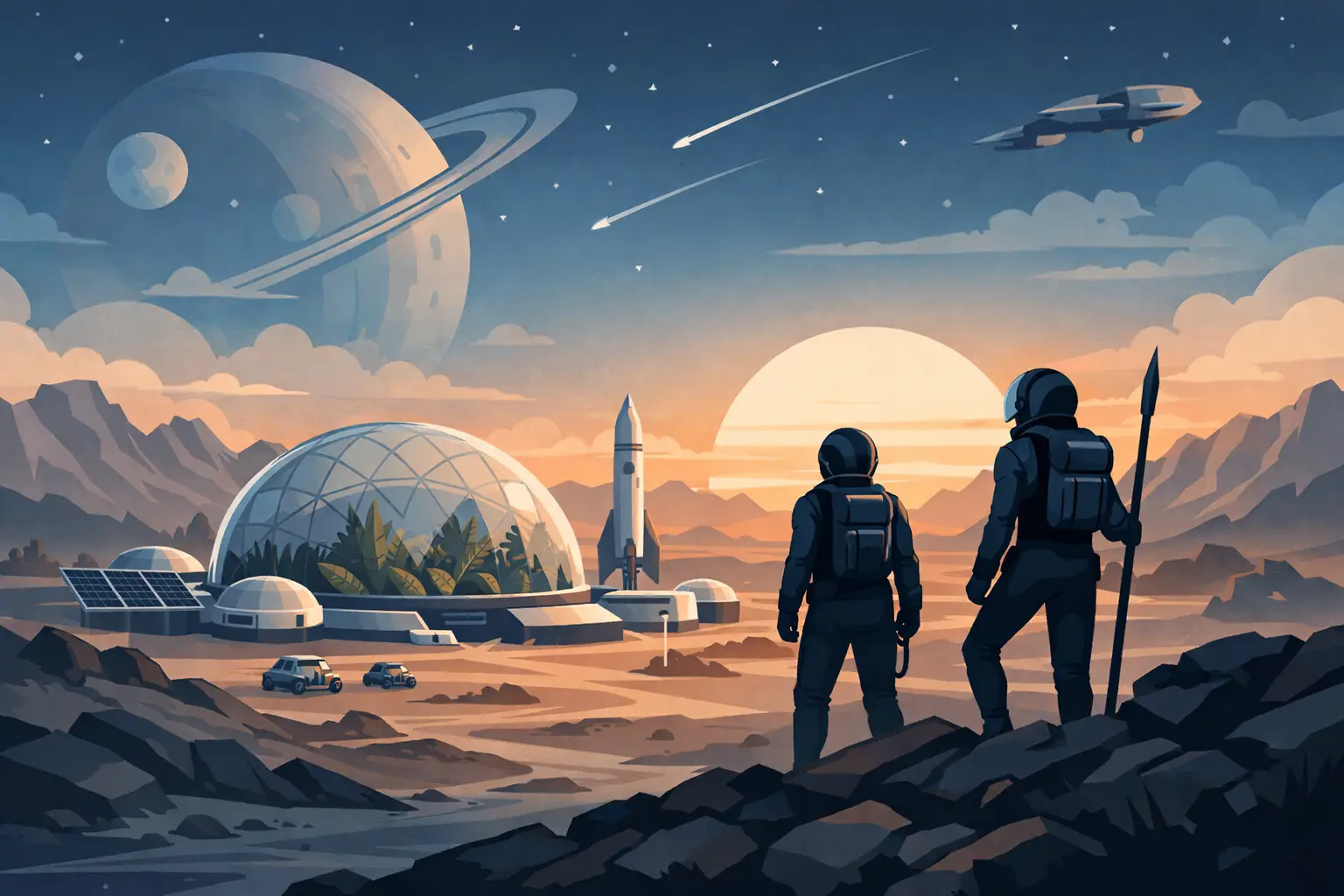
The air is failing. The colony is weeks from collapse. A signal arrives from somewhere impossible – another timeline, another intelligence, another version of humanity that may already have lost. That is where science fiction about human survival becomes truly gripping. Not when bodies run from explosions, but when minds, values, and civilizations are forced to answer a harder question: what deserves to survive?
The strongest survival stories in science fiction are never only about scarcity. Food, oxygen, heat, shelter – those are the immediate pressures, and they matter. But the genre earns its power when physical danger collides with moral consequence. A crew stranded beyond Earth is interesting. A crew that must decide whether to alter time, abandon another settlement, or risk human identity itself is unforgettable.
That distinction matters for readers who want more than surface-level peril. Survival in serious science fiction is not a countdown clock pasted onto a generic adventure. It is a confrontation with scale. A dying biosphere, a fractured timeline, a hostile planet, or an encounter with alien intelligence each strips away comforting assumptions. What remains is the exposed architecture of human character.
Why science fiction about human survival hits so hard
At its best, this kind of fiction places humanity under pressure in a way no other genre can match. Realist fiction can explore endurance within familiar limits. Science fiction expands the frame. It can ask what survival means when the battlefield is Mars, when cause and effect no longer behave, or when the threat is not invasion but irrelevance.
That is why the emotional force lands differently. Survival stories in space or across parallel timelines are not just larger in scale. They are more revealing. They force people to act without the support systems civilization usually takes for granted. Laws weaken. Institutions fracture. Memory becomes unreliable. Technology saves lives in one moment and creates catastrophe in the next.
The result is a rare fusion of urgency and reflection. Readers get the propulsion of danger, but also the deeper reward of wrestling with consequences. If a species can only continue by changing itself beyond recognition, is that survival or surrender? If one timeline can be saved only by sacrificing another, who gets to make that choice?
The best survival stories are really about limits
A great many books and films mistake destruction for depth. They present extinction-level stakes and assume scale alone will do the work. It rarely does. Spectacle can shock, but it does not necessarily endure.
The more lasting stories define survival through limits. Scientific limits, certainly. A ship has finite fuel. A habitat can recycle only so much air. Relativistic travel distorts time and severs ordinary human bonds. But the sharper limits are often psychological and ethical. How long can isolation be endured before judgment collapses? How much uncertainty can a leader absorb before authority turns cruel? How much can a society compromise before it no longer deserves to continue?
This is where hard science fiction becomes especially potent. When the science is treated seriously, survival stops feeling like magic. Every solution has mass, energy, delay, and cost. The pressure becomes credible. Readers are not merely told that the characters are trapped. They can feel the trap in the equations, the engineering, the impossible timing, and the cold indifference of physics.
That credibility amplifies the drama. The story does not need to exaggerate because reality, properly understood, is already severe enough.
Survival is not always heroic
One of the richest tensions in the genre is that survival can produce admirable courage or devastating compromise. Sometimes the brave decision is to preserve a mission. Sometimes it is to abandon the mission and save the people. Sometimes there is no clean distinction.
That ambiguity is not a weakness. It is the point. Human survival under extreme conditions reveals that nobility and desperation often share the same room. A scientist may break protocol to save a colony and trigger a larger disaster. A commander may preserve order by suppressing truth. A parent may choose one child, one shuttle seat, one possible future.
Science fiction has the range to honor these choices without flattening them into slogans. It can present survival as a field of competing obligations rather than a simple test of toughness.
Time, space, and the survival of identity
Some of the most compelling survival fiction is not about whether human bodies can endure, but whether human identity can. Time travel, wormholes, memory transfer, and parallel timelines all introduce a more unsettling threat than starvation or exposure. They ask whether continuity of self can survive radical displacement.
Imagine a civilization saved by sending knowledge backward through time. The species lives. But the people who made the sacrifice may be erased by the very act that preserves humanity. Is that victory? It depends on how the story understands personhood, memory, and historical consequence.
Or consider parallel timelines. One branch thrives, another collapses. Contact becomes possible between them. Aid is not free. Intervention alters both realities. Survival then becomes a question of which future humanity is willing to authorize.
These are not abstract puzzles for their own sake. They deepen the emotional charge because they place the human heart inside vast systems. Love, grief, loyalty, and guilt do not vanish in the presence of advanced physics. They become more volatile.
This is one reason concept-driven fiction can feel intensely personal when it is done well. The more ambitious the speculative framework, the more exposed the human stakes become.
Alien intelligence changes the survival equation
When alien life enters a survival story, the genre can shift from endurance to redefinition. An alien species may be hostile, indifferent, incomprehensible, or morally advanced in ways that make humanity seem primitive. Any of those possibilities can destabilize the idea that survival means simply defeating an enemy.
Sometimes the threat is obvious. A stronger intelligence competes for territory or resources. More interesting, though, are the stories where contact forces humanity to recognize its own limitations. What if the aliens do not want war, but regard human consciousness as transitional? What if cooperation requires surrendering categories we think of as essential – individuality, nationhood, linear time, even mortality?
Then survival is no longer only biological. It becomes civilizational and philosophical. Humanity may continue, but in altered form. Whether that future is liberation or loss depends on the story’s moral center.
That is where ambitious science fiction separates itself from simple invasion narratives. The danger is not merely that humans will die. It is that they may survive by becoming something unrecognizable.
Why readers keep coming back to these stories
Readers drawn to science fiction about human survival are often looking for a particular intensity. They want scale, yes, but not empty scale. They want ideas that carry emotional voltage. They want stories where scientific possibility and human consequence are fused so tightly that one cannot be peeled away from the other.
There is also a deeper appeal. Survival fiction gives form to fears that are already present in modern life – ecological precarity, technological acceleration, social fragmentation, and the suspicion that history can turn faster than institutions can respond. Science fiction does not merely mirror those anxieties. It enlarges them until they can be examined.
That enlargement can be grim, but it can also be strangely energizing. The genre reminds us that pressure reveals capacity. Human beings fail magnificently in these stories, but they also improvise, endure, adapt, and imagine. Even in bleak narratives, there is often a fierce respect for consciousness under strain.
For readers who crave hard science fiction with emotional and philosophical stakes, that balance is the real prize. A novel can stage orbital mechanics, temporal paradox, alien contact, and planetary collapse, but if it forgets the human cost, it remains only machinery. The opposite is also true. Emotion without conceptual rigor may move quickly, but it rarely lingers.
The memorable works hold both lines. They understand that survival is physical, moral, and metaphysical all at once. That is also why authors working in this space, including J. Thomas Hunton, often gravitate toward the intersection of time, space, and humanity. It is where the genre’s most thrilling questions live.
What makes a survival story worth your time
If you are choosing what to read next, look for stories that treat danger as more than scenery. The strongest ones build pressure from the underlying science, give real weight to decision-making, and allow survival to remain ethically complicated. They do not hand out easy victories. They understand that every rescue closes one door and opens another.
It also helps to know your own taste. Some readers want closed-system survival – ships, stations, colonies, and the brutal arithmetic of limited resources. Others prefer timeline fractures, first contact, or post-collapse societies rebuilding under impossible conditions. Neither approach is inherently better. The difference is where the story locates its deepest threat: in the environment, in technology, in other minds, or in humanity itself.
The most resonant science fiction about human survival refuses to let those categories stay separate for long. A failed machine becomes a test of leadership. An alien message becomes a referendum on memory. A mission to preserve the species becomes an argument about what the species actually is.
That is why these stories stay with us. They are not merely rehearsals for disaster. They are thought experiments charged with emotion, pressure, and wonder. They ask what survives when certainty is gone – and whether survival without meaning is enough.