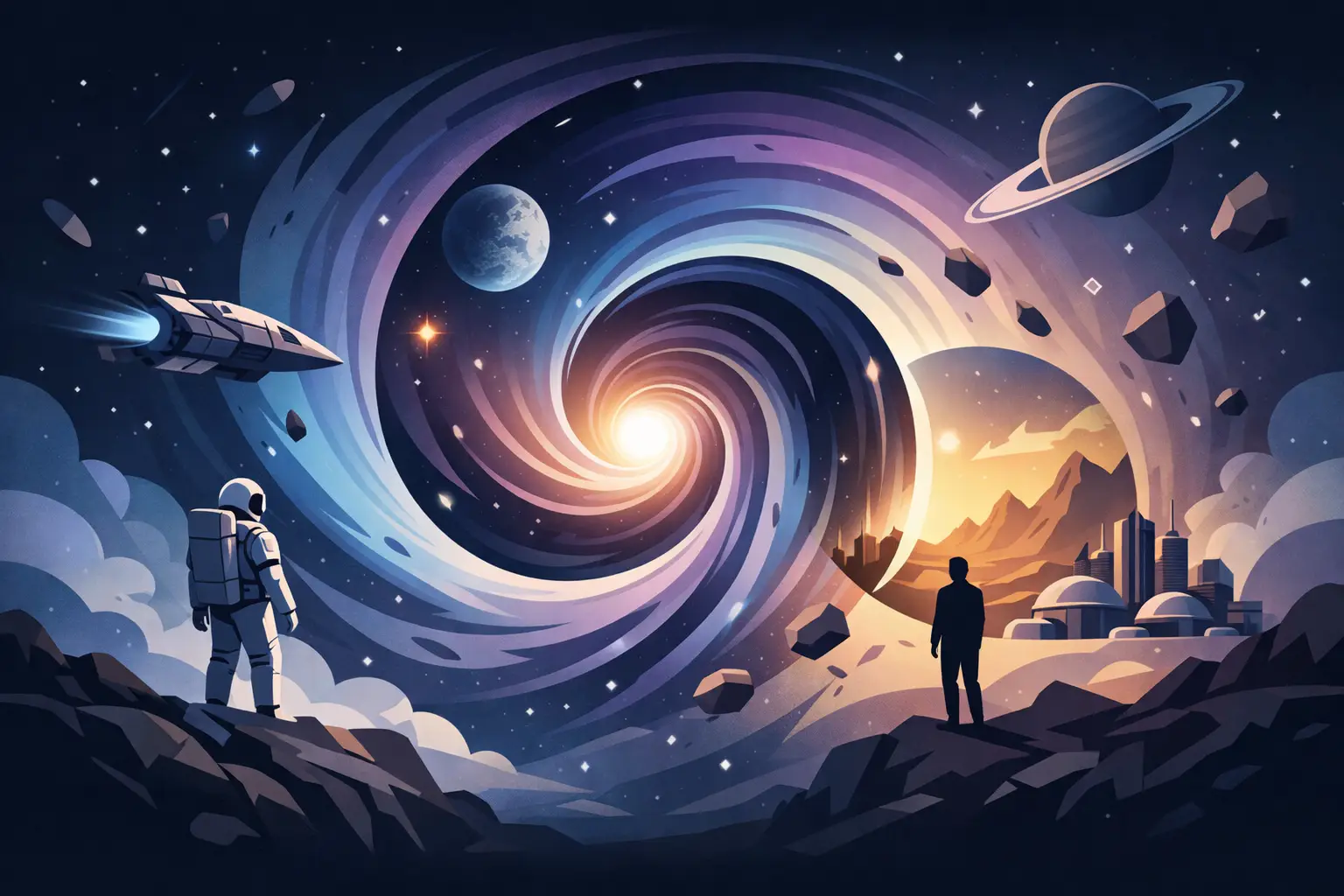
The difference between a gimmick and a great wormhole story usually appears in the first few pages. If the wormhole exists only to move characters from danger to spectacle, the illusion breaks fast. But the best examples of believable wormhole fiction treat the phenomenon as more than a cosmic shortcut. They treat it as a wound in spacetime, a technological temptation, and a moral test for everyone who dares to cross it.
That distinction matters to serious science fiction readers because wormholes sit at the fault line between wonder and discipline. They invite vast ideas – relativistic travel, causality traps, contact across impossible distances – yet they only feel persuasive when a writer respects the physics enough to preserve consequence. Believability in this corner of the genre does not require textbook certainty. It requires internal rigor, a sense that the story understands what such a passage through spacetime would cost.
What makes examples of believable wormhole fiction work
A believable wormhole narrative usually begins with limits. The passage may be unstable, energy-hungry, artificially maintained, or poorly understood. It may distort time as much as distance. It may force governments, scientists, and ordinary people into decisions they are not remotely prepared to make. Once those pressures enter the story, the wormhole stops being decoration and becomes infrastructure, threat, and revelation at once.
The strongest writers also resist a common temptation. They do not let the wormhole solve every problem. In fact, the more credible stories often make it create new ones. A traversable bridge between stars can destabilize politics. A tunnel through spacetime can create asymmetry between travelers and those left behind. Even a successful transit can produce the classic hard science fiction question: if humanity gains reach faster than wisdom, what exactly have we opened?
7 examples of believable wormhole fiction
Contact by Carl Sagan
Sagan approached speculative physics with the seriousness of someone who had spent a career explaining the cosmos without diminishing its mystery. In Contact, the machinery of interstellar passage feels believable not because every technical detail is explained beyond doubt, but because the novel understands scale, uncertainty, and scientific procedure. The journey is framed as an engineered event with enormous political, philosophical, and epistemic consequences.
What gives the book its staying power is that the wormhole-like transit is not merely transportation. It becomes a test of evidence, trust, and human interpretation. Sagan knew that a truly world-shaking scientific event would not produce universal clarity. It would produce argument, doubt, and competing visions of meaning. That is exactly why the speculative leap feels earned.
The Forever War by Joe Haldeman
Haldeman’s novel is not always the first title people cite in this conversation, but it belongs here because it treats relativistic displacement with brutal coherence. The story’s travel systems create the emotional truth that many wormhole stories chase – the feeling that movement through deep space tears human continuity apart.
Even when the mechanism is not presented as a simple pop-science portal, the book captures the central challenge of believable spacetime fiction: travel changes chronology. Soldiers return to a civilization that has moved on without them. The science fiction idea lands because the human cost lands first. Haldeman never lets cosmic scale erase psychological damage.
Hyperion by Dan Simmons
Hyperion is more baroque and more mythic than strict hard science fiction, yet its farcaster network remains one of the genre’s most memorable uses of controlled spacetime passage. What makes it believable within the novel’s architecture is that the network reshapes civilization at every level. Economics, warfare, architecture, intimacy, and political control all bend around the existence of near-instant movement.
That systems-level thinking is the key. Believable wormhole fiction asks a simple question too many weaker stories ignore: if this technology existed, what would it do to everything else? Simmons answers with ambition. His universe does not merely feature spacetime shortcuts. It has been rebuilt around them, and that gives the concept weight.
Pandora’s Star by Peter F. Hamilton
Hamilton excels at large-scale speculative engineering, and Pandora’s Star offers one of the clearest examples of a wormhole concept integrated into daily life without losing its grandeur. His interstellar society uses wormhole-like pathways not just for exploration but for commerce, transit, and political expansion. The result is a future that feels designed rather than improvised.
What makes the fiction believable is its attention to secondary consequences. Connectivity creates prosperity, but it also creates vulnerability. Borders become porous. Threats move differently. Discovery accelerates beyond control. Hamilton understands that revolutionary transport is never only about movement. It is about power, and power always reorganizes a civilization’s fears.
The Light of Other Days by Arthur C. Clarke and Stephen Baxter
This novel is more directly concerned with wormholes as instruments of observation than transportation, and that choice is precisely what makes it so compelling. Clarke and Baxter ask what happens when tiny wormholes make privacy obsolete and history transparent. The premise remains scientifically speculative, yet the narrative treats it with cool, relentless logic.
This is a useful reminder that believable wormhole fiction does not need a starship plunging into a glowing tunnel. Sometimes the more persuasive approach is narrower and more devastating. If wormholes become a practical tool, the first revolution may not be travel at all. It may be surveillance, archaeology, intimacy, and the collapse of secrecy. That kind of conceptual discipline is hard science fiction at its sharpest.
Interstellar by Christopher Nolan and Jonathan Nolan
Though primarily known as a film, Interstellar deserves a place in any serious discussion of believable wormhole fiction because it made unusual efforts to ground its central imagery in contemporary theoretical physics. The wormhole near Saturn is presented with a visual and conceptual seriousness that helped mainstream audiences grasp that such structures, if they exist, would be distortions in spacetime rather than fantasy gateways.
Its greatest strength is not perfect realism. No story at this scale gets a free pass from simplification. Its strength is that the wormhole exists inside a larger framework of relativity, gravity, time dilation, and survival. The film understands that a passage through spacetime should change more than location. It should change relationships, memory, and the meaning of sacrifice.
Diaspora by Greg Egan
If believability for you means maximal intellectual rigor, Egan is difficult to ignore. Diaspora operates at a level of conceptual intensity that can feel almost austere, yet that is part of its power. The novel treats exotic physics not as a decorative layer but as the governing reality of the narrative.
Egan’s speculative structures demand attention, but they reward it because every leap carries mathematical and philosophical intent. In his hands, wormhole-adjacent ideas feel believable not because they are easy, but because they are uncompromising. He writes as if intelligence itself is being tested by the universe, and that is often the deepest promise of hard science fiction.
Why these examples of believable wormhole fiction endure
They endure because each one understands a different truth about spacetime storytelling. Some focus on scientific method. Some focus on civilizational redesign. Some focus on relativity as emotional violence. Some treat wormholes as a doorway to first contact, while others expose them as engines of surveillance or instruments of empire.
The trade-off is that not all of these works deliver the same kind of satisfaction. If you want strict engineering plausibility, Hyperion may feel too operatic. If you want emotional accessibility, Diaspora may feel forbidding. If you want a wormhole to remain mysterious, Hamilton’s infrastructural approach may feel almost too practical. But that range is exactly what makes the subgenre worth reading. Believability is not one thing. It can mean scientific restraint, coherent consequences, or psychological truth.
The deeper standard for wormhole fiction
A believable wormhole is not just a hole. It is a decision embedded in physics. It asks whether distance is a barrier, whether causality can be trusted, whether exploration is noble or reckless, and whether the human mind can survive contact with scales it was never built to hold.
That is why the best stories in this territory feel so charged. They stand at the intersection of time, space, and humanity, where every breakthrough carries the shadow of distortion. For readers who want science fiction to think as fiercely as it dreams, wormholes remain one of the genre’s richest tests.
And if you are still hunting for the next great read, choose the story that treats passage through spacetime as more than spectacle. Choose the one that understands a tunnel between stars should also open something inside the people who enter it.