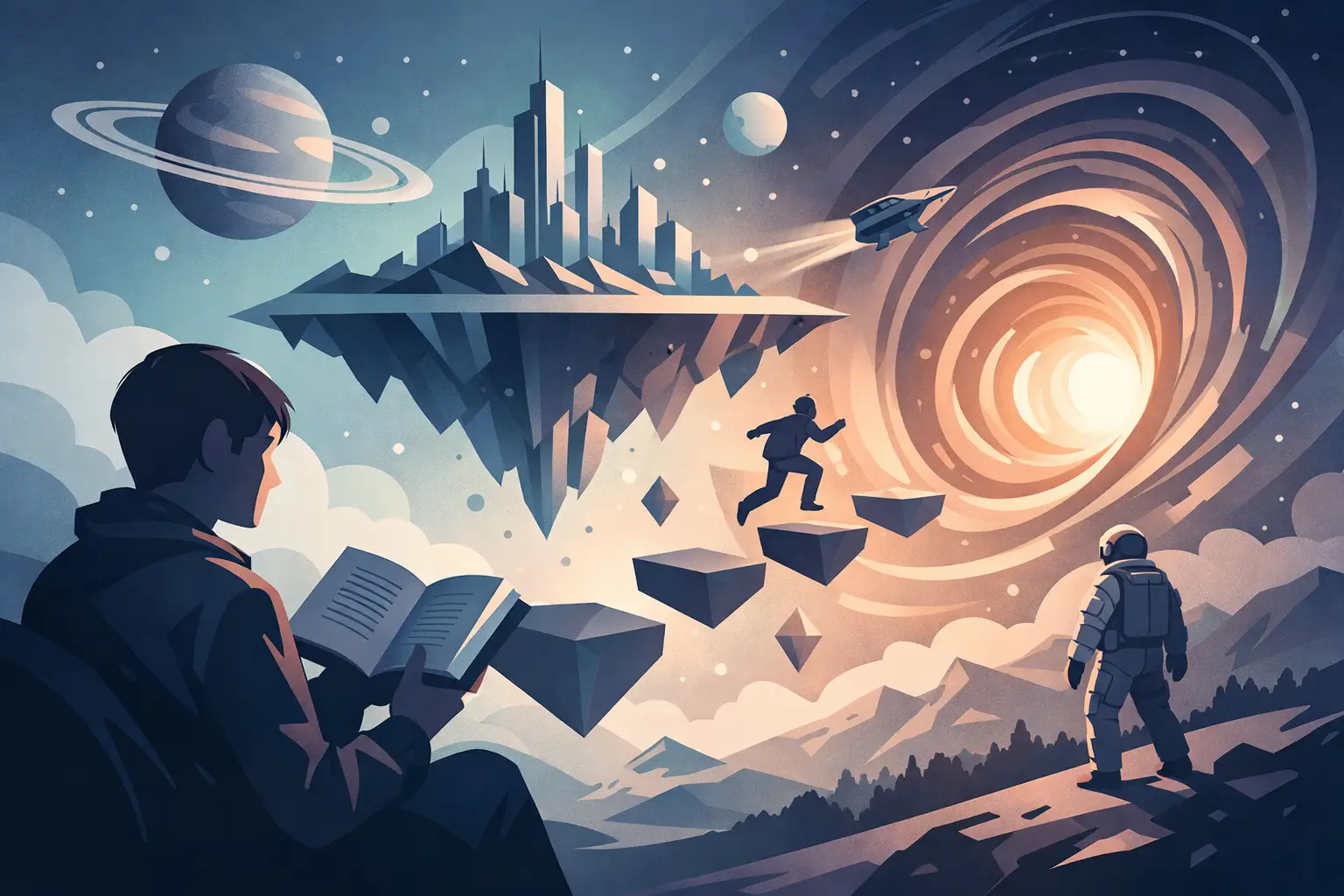
A wormhole opens, but crossing it may erase the life you remember. A message arrives from a future that should not exist. Two versions of the same person make opposite choices, and both may be right. Why do readers enjoy mind bending sci fi? Because it turns the largest questions imaginable into intimate pressure points: Who are we when reality itself refuses to stay fixed?
This kind of science fiction does more than offer strange technologies or distant planets. It places readers at the intersection of time, space, and humanity, then asks them to live with the consequences. The pleasure is not simply in solving a puzzle. It is in feeling the ground shift beneath familiar ideas about identity, memory, free will, survival, and destiny.
Why Do Readers Enjoy Mind-Bending Sci-Fi So Deeply?
Mind-bending science fiction gives readers the rare sensation of encountering an idea bigger than their current mental map. A well-built paradox, alternate timeline, or alien intelligence is not merely a twist. It is an invitation to reconsider the rules that organize ordinary life.
Readers may begin with a question that sounds technical: Can information travel backward through time? What happens if a ship returns to Earth after centuries pass elsewhere? Could a nonhuman mind perceive causality in a way people cannot? Yet the story becomes powerful when the scientific premise presses on something human. A time traveler is not only trying to repair history. They may be trying to save a child, preserve a promise, or face the damage caused by believing they can control everything.
That marriage of rigorous speculation and emotional consequence is the genre’s charge. Big ideas matter because people must bear their weight.
The Brain Enjoys a Puzzle With Stakes
There is a particular satisfaction in a story that asks readers to participate. Mind-bending sci-fi often withholds complete explanations at first. It supplies fragments: an impossible observation, a contradiction in a timeline, a signal from beyond known space. Readers gather those pieces, test theories, and revise their assumptions as new evidence emerges.
This is not passive entertainment. It is a form of intellectual adventure.
The strongest stories reward close attention without making comprehension feel like homework. They establish rules, challenge those rules, and eventually reveal why the details mattered. When the final shape of the story clicks into place, readers experience both surprise and recognition. The answer was hidden in plain sight, but the reader had to grow into it.
There is a trade-off, of course. A story can become so devoted to its mechanism that the characters feel like pieces on a physics board. Readers who seek hard science fiction usually welcome complexity, but they still need an emotional center. The equation may be elegant, yet it becomes unforgettable only when someone has something profound to lose.
Reality Becomes Strange Again
Daily life trains people to accept reality as stable. Cause comes before effect. Distance separates places. The past is finished. Mind-bending science fiction restores the strangeness of those assumptions.
Time travel makes the past negotiable, but never harmless. Parallel timelines suggest that every decision may contain worlds of unrealized consequence. Relativistic travel makes distance a force that can divide families and civilizations. Alien intelligence challenges the comforting belief that human perception is the final measure of what is real.
These concepts fascinate readers because they do not feel entirely arbitrary. They emerge from genuine scientific questions, even when fiction pushes beyond what is currently possible. Black holes, quantum uncertainty, spacetime, and the vast age of the universe are already humbling. Science fiction gives those realities narrative force.
The result is a renewed sense of wonder. A hallway, a radio transmission, or a familiar face can become charged with possibility when the reader understands that time may be fractured or perception may be unreliable. The world becomes larger, stranger, and more alive.
The Best Paradoxes Are About People
A temporal paradox is compelling because it can become a moral paradox. If a character can prevent a tragedy, do they have an obligation to do so? If saving one life destroys another timeline, what does responsibility mean? If a future version of yourself orders you to commit an atrocity for the sake of survival, is refusal courage or catastrophic selfishness?
Mind-bending sci-fi gives these questions a dramatic form. Rather than discussing free will in the abstract, it places a character inside a causal loop. Rather than casually debating whether identity survives radical change, it introduces a duplicate, an uploaded consciousness, or a traveler who has lived decades beyond everyone they love.
Readers are drawn to this tension because there are no easy exits. The genre can expose the limits of simple moral certainty without surrendering to nihilism. A difficult choice still matters, even if the universe is vast and time is unstable. In some ways, it matters more.
Scale Makes Human Emotion More Intense
Space opera and hard science fiction can span galaxies, centuries, and civilizations. That scale does not diminish human feeling. It magnifies it.
Imagine receiving a message from a loved one sent across light-years, knowing the reply will arrive after both of your lives have changed. Imagine waking from suspended animation to learn that Earth is no longer the world you left. Imagine discovering that humanity’s first contact with alien intelligence has turned on one decision you made before anyone understood the stakes.
Such scenarios transform private emotions into cosmic events. Grief becomes interstellar. Loyalty must survive across impossible distances. Love confronts the cold mathematics of time dilation. Readers enjoy the spectacle, but they stay for the ache beneath it.
This is why scientific imagination and human depth should not be treated as opposing forces. The most ambitious concepts create the conditions for equally ambitious emotion.
Uncertainty Is Part of the Attraction
Many stories promise clarity: a villain is defeated, a mystery is solved, order is restored. Mind-bending sci-fi often offers something more unsettling and more honest. It recognizes that knowledge can expand the horizon of uncertainty.
A crew may learn what created a wormhole but not whether using it is wise. Researchers may communicate with an alien presence without ever translating its deepest intentions. A character may understand the structure of a timeline while remaining unable to escape the consequences of their choices.
For some readers, that ambiguity is frustrating. They want every rule stated and every thread tied off. For others, it is exactly the point. The unknown is not a failure of the story when it has been earned. It is a reminder that the universe does not owe humanity a comfortable explanation.
The difference lies in discipline. Productive ambiguity leaves readers with questions that echo because the story has given them enough substance to wrestle with. Empty ambiguity hides behind confusion because it has nothing meaningful to reveal.
Mind-Bending Sci-Fi Respects the Reader
At its best, this genre trusts readers to keep up. It does not flatten advanced ideas into decoration, nor does it assume that a scientific concept must be stripped of complexity to be exciting. Readers who love speculative fiction often want to feel challenged. They want the thrill of confronting an unfamiliar framework and gradually seeing through it.
That respect also appears in the way serious sci-fi treats consequences. A wormhole is not just a shortcut for the plot. It changes economics, warfare, migration, family, and power. Parallel worlds are not simply an excuse for alternate costumes. They force questions about the uniqueness of a life and the meaning of a choice. A first-contact encounter does not end when the aliens appear. It begins when humanity realizes it may not be the smartest voice in the conversation.
Stories such as the Displacement series draw power from this territory: the collision of scientific possibility with the fragile, defiant human need to make choices that matter.
Wonder Is Not Escapism Alone
Readers do escape into mind-bending sci-fi, but escape is only part of the experience. The genre can return them to their own lives with sharper eyes. A story about altered timelines may make them consider the weight of a small decision. A novel about isolated explorers may reveal how much connection depends on presence. A confrontation with alien intelligence may expose the assumptions hidden inside human confidence.
That is the lasting appeal. These stories do not make reality smaller by replacing it with fantasy. They make reality more mysterious by showing how much remains beyond the edge of certainty.
When choosing your next mind-bending science fiction read, look for more than a clever premise. Look for a story whose impossible question reaches into a recognizable human fear, hope, or obligation. The concept may bend time and space, but the experience becomes unforgettable when it also bends your understanding of what it means to be human.