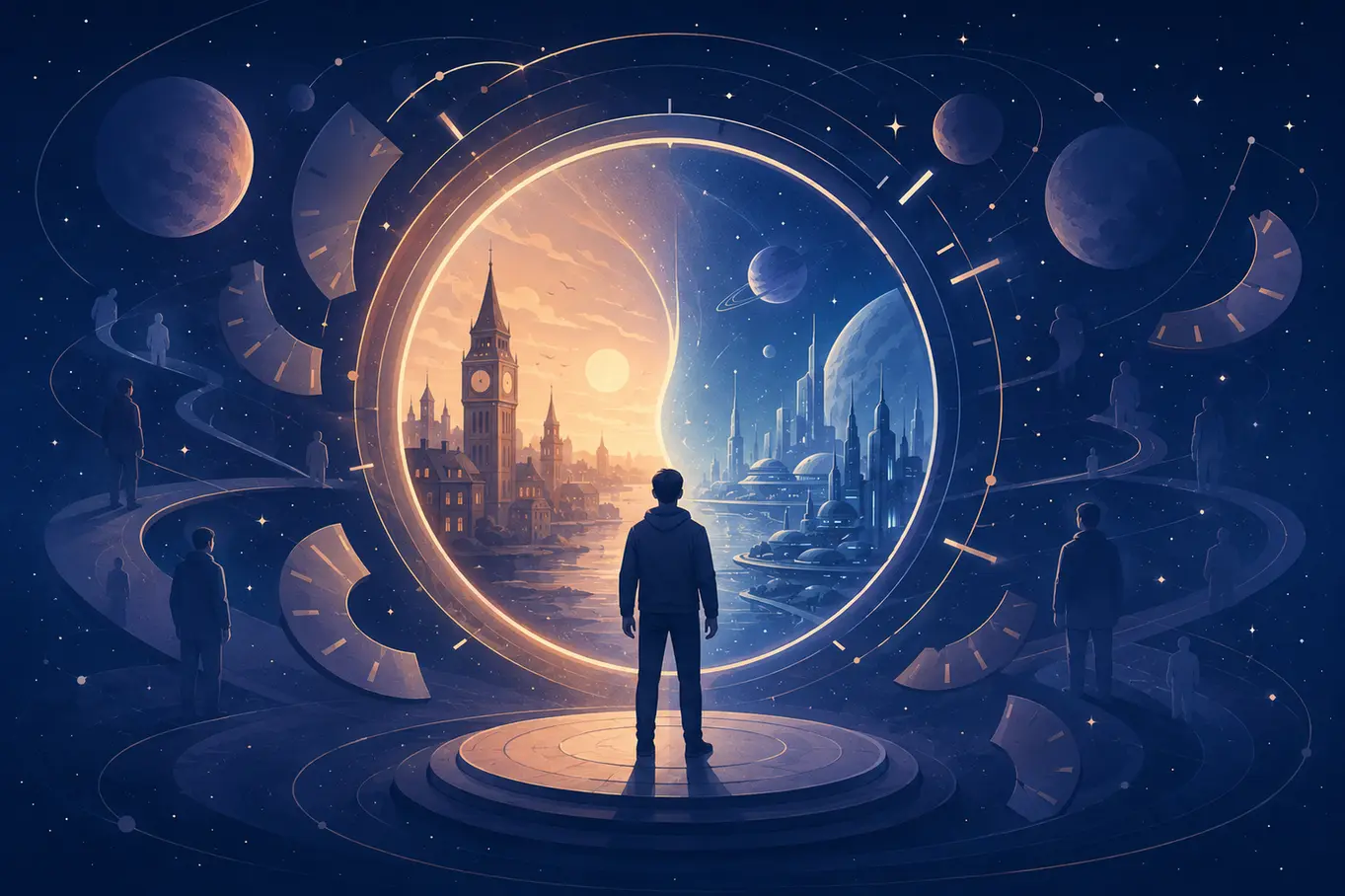
Time displacement brings a unique strength to science fiction.
It’s not just about moving a character through time. Time displacement pulls them out of the life they once knew and into a world that has changed while they were gone.
This idea leads to powerful drama and raises important questions.
What happens when a person loses years in a moment? What happens when home still exists, but it no longer feels the same? What happens when one mission changes the course of a life, a family, or an entire world?
That’s why time displacement is so effective in science fiction. It makes the adventure feel more personal.
Time Displacement Changes the Meaning of Home
In many science fiction books, characters travel through space. They visit new planets. They meet new beings. They face danger far from Earth.
Time displacement adds something extra.
A character might come back to the same planet, city, or family, but time changes everything. People get older, families move forward, and societies change. The world doesn’t stay the same.
This leads to a difficult truth.
Home is not only a location. Home also lives in time.
When a character loses time, they lose part of where they belong. They might recognize the land, the sky, or the buildings, but still feel like outsiders.
This feeling gives time displacement stories their emotional impact.
Lost Time Creates Real Stakes
Science fiction often deals with big ideas. Ships travel across galaxies, civilizations rise and fall, and strange forces shape space and reality.
But readers connect most when the story relates to real human experiences.
Lost time does that.
A character might survive danger but still lose something important. They can come back alive, yet miss years they’ll never get back. Children grow up, partners get older, friends change, and the world keeps moving forward.
This makes time displacement more than just a science fiction tool.
It becomes a human problem.
The character has to face what time has taken from them. They need to accept that surviving doesn’t erase what they’ve lost, and figure out how to move on in a world that no longer feels familiar. And that’s why these stories stick with readers. Science sets up the situation, but emotion gives it meaning.
Changed Timelines Raise Hard Questions
Time displacement also brings up moral questions.
If a character sees a damaged future, should they try to change it? If changing the past saves lives, is it still dangerous? If one action creates a better world, what happens to the people from the old one?
Science fiction uses altered timelines to examine choices and their consequences.
Every decision is important. A small action in one time can lead to big changes in another. What starts as exploration can become an unexpected responsibility.
This creates tension because there isn’t an easy answer.
Changing the past might fix one problem but cause another. Protecting the timeline could mean letting suffering continue. The character has to choose what matters most.
This is where time displacement really makes us think.
It encourages readers to consider action, risk, sacrifice, and responsibility.
Space Makes Time Feel Bigger
Time displacement is especially effective in space-set science fiction.
Space already makes people feel small. It shows us distance, silence, and mystery, and reminds us that Earth is just one part of a much bigger universe.
When time becomes part of the story, everything feels even bigger.
A crew might travel through space and discover that time moves in surprising ways. They could return to a future they don’t recognize, meet societies changed by centuries, and see what humanity becomes after years of growth, fear, discovery, or failure.
This adds depth to the story.
Space shows how far people can travel, while time reveals what that journey costs.
Together, space and time make science fiction feel both vast and personal.
Time Displacement Tests Identity
A character who’s been displaced has to ask a tough question.
Who am I now?
The answer isn’t always clear.
The character might remember the old world and hold on to old promises, relationships, and beliefs, but the new world might not have them anymore.
This causes inner conflict for the character.
They have to choose whether to hold on, adapt, or fight for what they still believe is important.
That struggle makes the story feel more human. Readers see more than just a mission—they see someone trying to stay true to themselves after everything around them has changed.
This is one reason why time travel and time displacement stories are still so popular. They let readers explore change through the characters, not just the plot.
How Displacement Uses This Idea
J. Thomas Hunton’s Displacement makes time displacement one of its strongest story elements.
Georgia and her crew start out on a space mission, expecting danger, discovery, and tough choices. But their journey goes far beyond a typical mission.
They encounter strange forces, advanced societies, and a future that doesn’t match the world they left. Time changes what it means for them to return, and it also changes their sense of duty.
The story links space exploration to emotional loss, showing how a mission can affect family, identity, and humanity’s future.
This gives the book more than just a science fiction backdrop—it gives the story a human core.
Georgia faces more than the unknown; she faces the cost of time itself.
Why Readers Connect With This Theme
Time displacement resonates because everyone understands time.
People know what it means to miss a moment. They know how fast life can change. They know that some years never return.
Science fiction takes that familiar truth and puts it in a bigger world. It uses ships, planets, advanced technology, and changed timelines to ask questions that feel close to real life.
What do we lose as time moves on?
What do we carry with us?
Can we still belong after everything changes?
These questions are what make time displacement so powerful. They give science fiction emotional depth and a lasting impact.
A good time displacement story doesn’t just ask where a character goes.
It asks how time changes them.