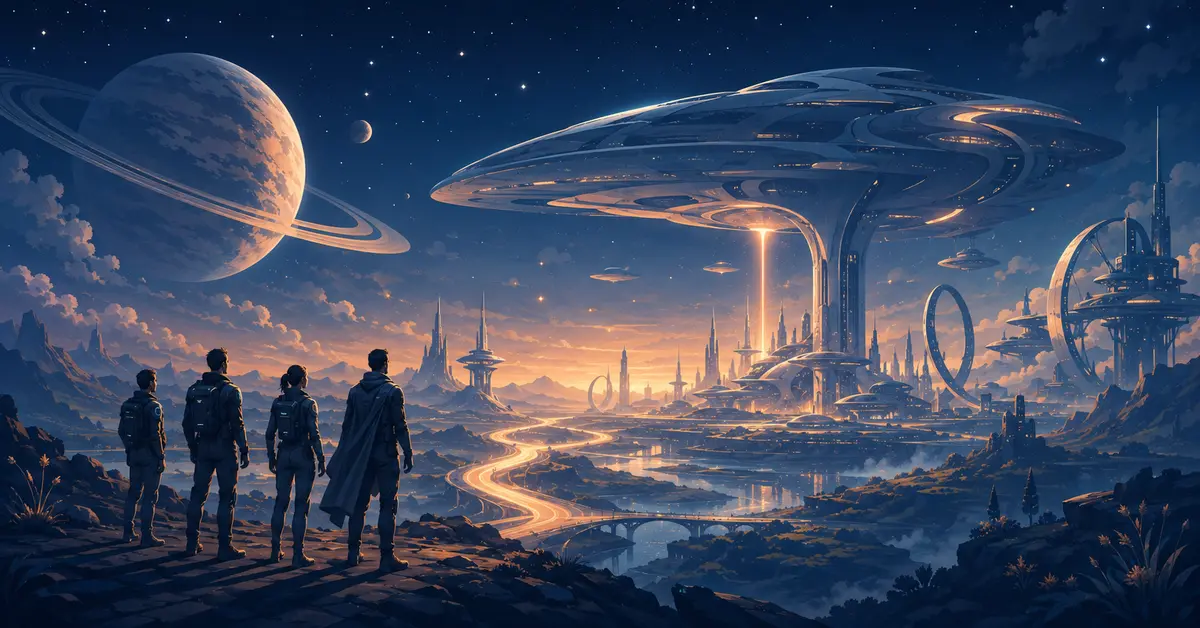
Science fiction often asks a simple question. What happens when humans meet a civilization that stands far ahead of us?
The answer is not simple.
Most people think about technology first. They imagine faster ships, stronger energy systems, better medicine, and machines that solve problems we still face today. Those ideas matter. They create excitement. They also create fear.
But an advanced civilization brings more than new tools. It brings a new way to see life, progress, power, and survival. That kind of contact changes how humans think about themselves.
A first contact story works best when it asks more than “Are they friendly?” It asks a deeper question. Are we ready to understand them?
First Contact Creates Fear and Wonder
If we ever get proof of intelligent life, the whole world would react.
Scientists would study every detail. Governments would try to stay in control. News channels would cover every update. People would talk about it everywhere—from homes and schools to offices and online.
Some people feel hope. Others might panic. Some refuse to believe it.
These reactions make sense. We understand the world through our own experiences. We know Earth, our history, and our limits. Meeting a more advanced civilization would shake that sense of comfort.
It tells us we are not alone. It also tells us we are not the most advanced minds in existence.
That idea feels exciting. It also feels uncomfortable.
Advanced Technology Changes Everything
A civilization that reaches Earth from deep space likely understands science at a level we cannot match.
It may know how to cross huge distances in space. It may use energy in cleaner and stronger ways. It may understand time, gravity, health, and communication better than we do.
This kind of knowledge can change human life.
Medicine could improve, space travel could expand, energy problems might shrink, and communication could become faster and more reliable. New discoveries could reshape every part of society.
But new technology also brings tough questions.
Who controls it?
Who receives it first?
Can humans use it safely?
Do powerful nations turn it into weapons?
An advanced civilization may offer answers, but humans still bring human problems. Fear, pride, ambition, and mistrust do not disappear overnight.
That is why the first contact creates conflict even without a war.
The Hardest Part Is Understanding Them
The biggest challenge may not be their technology. It may be their thinking.
A civilization thousands of years ahead of us may not see life the way we do. It may not organize society around nations, borders, money, or competition. It may view identity differently. It may value peace, knowledge, balance, or survival above everything else.
Humans may struggle with that.
We often measure progress by what we build. A more advanced civilization might measure it by what they choose not to destroy. They could see our conflicts as childish, our divisions as dangerous, and our potential before we even notice it.
That kind of encounter can humble humanity.
It can also push humanity to grow.
Science Fiction Uses Aliens to Study Humans
First contact stories are popular because they are not only about aliens.
They are about us.
When science fiction introduces an advanced alien civilization, it gives readers a mirror. We see our hopes in that mirror. We also see our weaknesses.
We see how humans react under pressure. We see how leaders respond to the unknown. We see how fear spreads. We see how curiosity survives.
That is why stories about intelligent life still interest readers. They ask big questions in a way that feels exciting and personal.
What do we protect?
What do we fear?
What do we become when we learn we are part of something larger?
These questions keep the genre alive.
Space Exploration Makes the Question Feel Real
Space exploration gives first contact stories a strong foundation.
Astronauts already represent courage, discipline, and curiosity. They leave Earth to study what most people only see from far away. They face danger in silence. They trust science, teamwork, and leadership.
When a space mission leads to contact with a more advanced civilization, the story becomes more human. The crew must think fast. They must make decisions with limited knowledge. They must protect Earth while trying to understand something far beyond their training.
This makes the story stronger.
It is not only about what waits in space. It is also about how people respond when space changes everything.
A Story Like Displacement Fits This Idea
J. Thomas Hunton’s Displacement works with this same idea.
The story follows Georgia and her crew as a space mission turns into something far bigger than a test flight. They face strange discoveries, advanced beings, time shifts, and future societies that force them to rethink humanity’s place in the universe.
The book does not treat advanced civilization as a simple threat. It uses the idea to explore discovery, responsibility, and change.
Georgia and her team do not only ask how to survive. They ask what their mission means for Earth, for the future, and for the people who come after them.
That is where the story connects with classic science fiction themes. It looks beyond the machine and focuses on the human response.
The Real Question Is About Humanity
Meeting a more advanced civilization changes more than science.
It changes perspective.
Humans start to ask new questions. We question our place in the universe. We question our ideas of progress. We question whether we are ready for the knowledge we seek.
That is why this theme remains powerful in science fiction books. It gives readers adventure, mystery, and imagination. It also gives them something deeper to think about.
A more advanced civilization may show us new technology. It may open the door to space travel and future societies. But its greatest impact comes from what it reveals about us.
The real question is not only whether they exist, but whether humanity is ready to meet them.