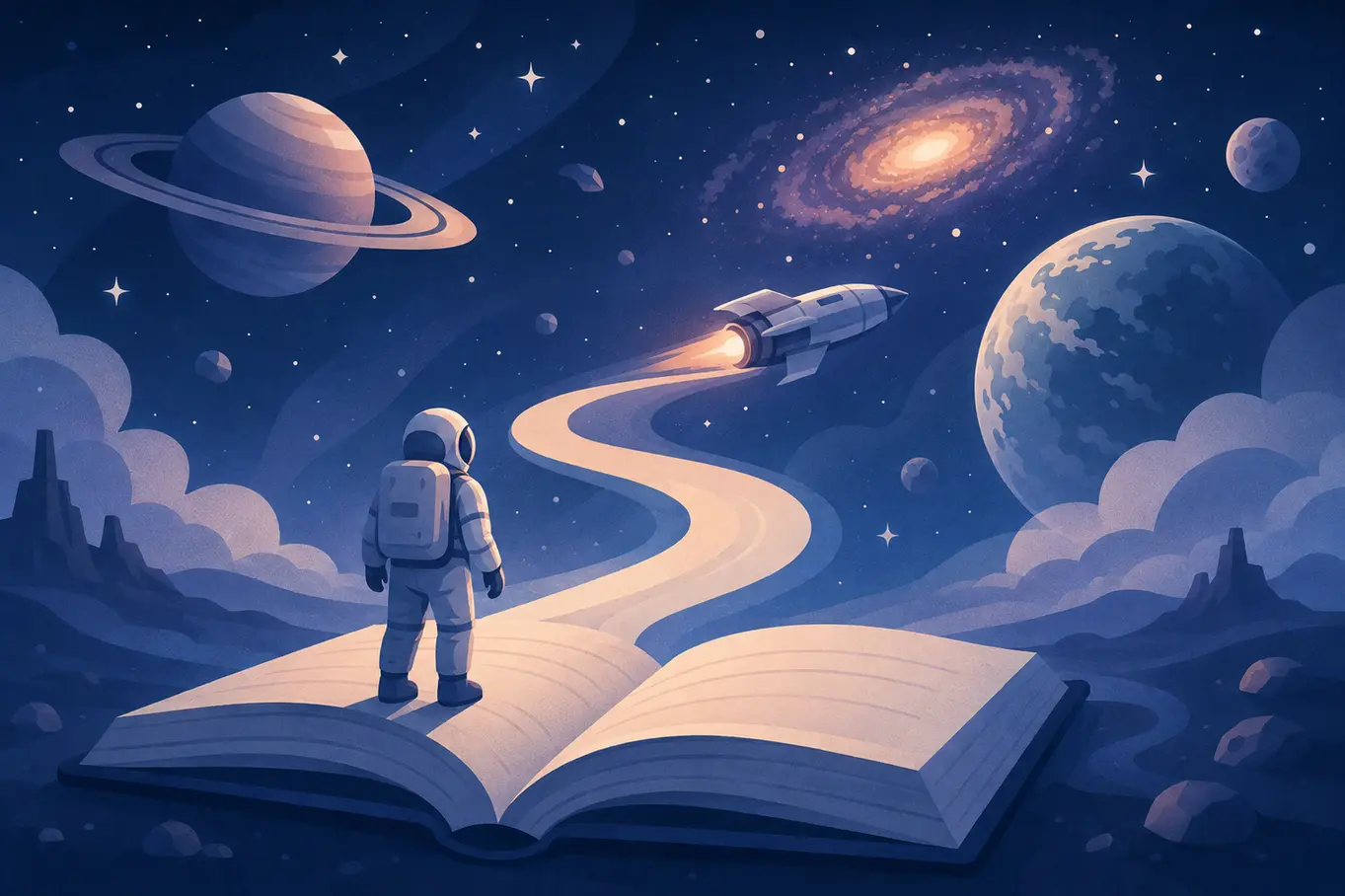
A sci-fi book about space exploration offers readers more than just a journey beyond Earth.
It raises a bigger question: What happens when people leave the world they know and face something they cannot fully understand?
This is why space exploration is such a powerful theme in science fiction. It brings together mystery, danger, science, discovery, and human emotion in a single story. The spaceship moves the plot, but the people on board give the story its heart.
Readers look for strange worlds, advanced technology, and unknown life. They also want to see fear, courage, and tough decisions. A good space exploration story delivers all of this.
A Journey Into the Unknown
Space exploration begins with curiosity.
People have always looked at the stars and wondered what lies beyond. Science fiction turns that curiosity into stories. It sends crews past the limits they know, placing them near new planets, strange phenomena, alien worlds, or forces that challenge everything they believe.
This creates a strong sense of momentum in the story.
The crew starts their mission with a clear plan, but then things change. A signal may appear, a ship malfunctions, a strange object approaches, or a discovery challenges what they thought they knew.
That moment matters.
It reminds readers that space is never truly ours. It stays vast, silent, and unpredictable. That feeling of the unknown keeps the story exciting.
Science and Imagination Work Together
A sci-fi book about space often uses science as a foundation.
Readers expect to see spacecraft, missions, sensors, engines, space stations, and advanced systems. These details make the story feel real and give it structure. The crew cannot solve every problem with feelings alone; they need skill, knowledge, and teamwork.
At the same time, science fiction lets imagination go even further.
The story can explore faster space travel, strange energy fields, time shifts, alien civilizations, and future technology. These ideas push the reader beyond everyday life.
The best space exploration stories balance both sides. They use enough science to feel believable. They use enough imagination to feel exciting.
That balance makes readers stay with the story.
The Crew Matters More Than the Ship
A spaceship can look impressive, but the crew carries the heart of the story.
Readers want to know how people act under pressure. They want to see leadership, fear, loyalty, doubt, and sacrifice. Space makes every problem feel sharper because help is far away.
A captain must make quick decisions. A pilot must stay calm. A scientist must study the unknown. An engineer must fix systems before disaster grows. Every person has a role.
This creates natural tension.
When the crew faces danger, readers feel it. When they argue, readers understand why. When they choose duty over comfort, the story gains emotional weight.
Space exploration works best when the mission tests the people as much as the technology.
First Contact Adds Bigger Questions
Many space exploration books include the chance of meeting intelligent life.
This changes the story.
First contact is exciting because it forces humans to face a larger reality. We learn another civilization exists. We see that human knowledge has limits. We also see how people react when they meet beings with greater power, older history, or different values.
A first contact story can create wonder. It can also create fear.
Can humans trust the beings they meet?
Do those beings want to help, study, warn, or control us?
How does Earth react when the crew brings back what they learn?
These questions make a sci-fi book about space exploration more meaningful. The story moves beyond travel. It becomes a test of human understanding.
Space Exploration Can Change Time
Space stories often focus on distance, but some also explore the idea of time.
This adds another layer to the story.
When characters travel too far, too fast, or through strange forces, time can change around them. They may return to a different Earth, meet future societies, or discover that a short mission for them means years or centuries for everyone else.
This idea makes space exploration more personal.
It shows that discovery has a cost. A crew may gain knowledge but lose time with family. They may save lives but lose their place in the world. They may return home and still feel displaced.
This is why time is such a powerful theme in science fiction. It turns a space mission into an emotional journey.
Future Societies Show Where Humanity May Go
A sci-fi book about space exploration often asks what humanity might become after long periods of change.
Future societies allow writers to explore progress. They show new cities, new systems, new values, and new forms of life. Some futures look beautiful. Some feel unsettling. Many do both at the same time.
Readers enjoy these worlds because they bring up important questions.
Does progress make people wiser?
Does advanced technology make society better?
Can humans grow without losing freedom, emotion, or identity?
These questions add depth to space exploration stories. The journey into space also becomes a journey into possible futures.
Displacement Fits This Kind of Story
J. Thomas Hunton’s Displacement touches on many of these ideas.
The book starts with a space mission led by Georgia and her crew. What begins as a simple exploration grows into something much bigger. They encounter an anomaly, advanced beings, time shifts, and future societies that challenge what they know about Earth and humanity.
In this story, space is more than just a setting. It’s where the crew faces the unknown and where science, time, and human choices come together.
This makes the book a great choice for anyone who enjoys science fiction about space exploration. It offers a mission, a crew, advanced technology, first contact, and big questions about humanity’s future.
Why Readers Keep Coming Back
Space exploration stories keep drawing us in because they speak to something deep inside us.
We want to know what lies beyond the familiar.
We want to understand the unknown.
We want to see how people respond when they face something larger than themselves.
A sci-fi book about space exploration gives readers that experience. It lets them travel beyond Earth while staying connected to human emotions. It offers stars, ships, strange discoveries, and big questions.
Most importantly, it reminds readers that exploration is never just about distance.
It’s about what people learn when they leave their comfort zone behind.