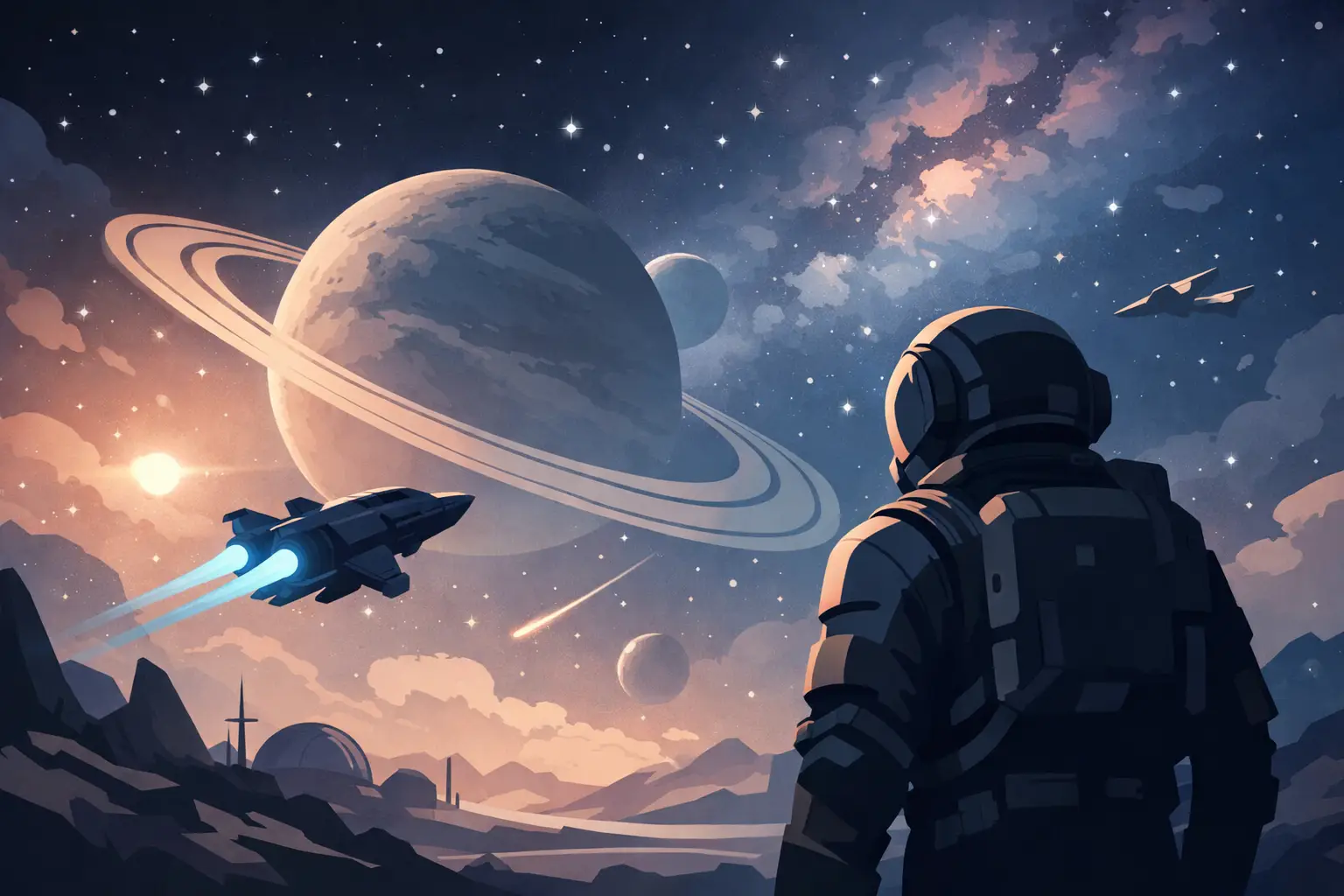
A ship crossing the void is never just a ship crossing the void. It is a sealed argument about what humanity carries with it when Earth is no longer close enough to save us. The finest deep space adventure novels understand that distance changes everything: time, language, memory, loyalty, and the meaning of survival itself.
A distant planet, an anomalous signal, or a passage through a wormhole can provide the spectacle. But spectacle alone does not create lasting science fiction. What makes a deep-space story matter is the pressure beneath the stars: the moment when scientific possibility collides with a human choice no equation can resolve.
Why Deep Space Adventure Novels Feel So Vast
Deep space expands the physical scale of a story while stripping its characters of easy answers. On Earth, a crisis may have institutions, history, and familiar boundaries around it. Beyond the solar system, those systems become fragile or irrelevant. A crew can be months, decades, or centuries from meaningful help. A message may arrive too late. A decision made in one orbit may reshape lives in another century.
That isolation gives the genre its special intensity. A malfunction is not merely a technical inconvenience. It can become an ethical test. Do you preserve fuel for a future destination or spend it rescuing strangers? Do you wake colonists from cryosleep early and risk the mission, or leave them unaware while systems fail? Do you return home when the home you knew may no longer exist?
Hard science fiction makes these stakes more convincing because it treats constraints as sources of drama. Relativity, radiation, limited propulsion, closed ecosystems, and communication delay are not obstacles to write around. They are the forces that shape character. The universe does not bend because the crew needs a clean victory.
The Best Adventures Begin With a Serious Question
Action has its place in deep-space fiction. A hull breach, an alien pursuit, or the discovery of a dead civilization can propel a reader through pages at speed. Yet memorable adventure rests on a larger question, one that continues to echo after the immediate danger has passed.
What does humanity become when it can alter time but cannot repair grief? What obligations does an exploratory mission owe to alien intelligence? Is colonization an act of courage, desperation, or repetition of an old human failure? When parallel timelines reveal versions of the lives we might have lived, which version deserves loyalty?
These questions give the genre intellectual gravity. They make distant worlds feel less like scenery and more like mirrors. A novel can place its characters at the edge of a black hole, but the deeper journey often concerns identity, responsibility, and the cost of knowing too much.
This is where scientific imagination becomes more than technical display. A credible wormhole is fascinating. A wormhole that forces a character to confront a life displaced by years, choices, or alternate history is unforgettable. The science creates the conditions. Human consequence gives those conditions meaning.
Wonder Needs Resistance
Readers come to space adventure for wonder, and they should receive it. There is a primal thrill in the first image of an impossible nebula, a derelict station drifting beyond a known map, or an artifact whose purpose resists every human theory. But wonder becomes shallow if nothing pushes back.
The universe should remain strange enough to challenge human assumptions. Alien intelligence should not simply be humanity in unfamiliar anatomy. New planets should not be convenient copies of Earth. Even a breakthrough should create fresh uncertainty, because every door opened in the cosmos reveals another darkness beyond it.
That resistance does not require bleakness. Hope is often more powerful when it is earned. A crew that chooses cooperation after mistrust, a scientist who accepts the limits of a theory, or a survivor who refuses to treat an alien world as property can bring real emotional force to a vast setting.
Science Is the Engine, Not the Decoration
There is no single formula for hard science fiction. Some novels focus closely on orbital mechanics, engineering, and biological systems. Others work at the speculative frontier, using time dilation, quantum phenomena, or higher-dimensional physics as disciplined possibilities rather than casual magic. The dividing line is not a page full of equations. It is respect for consequence.
If a ship can travel faster than light, what does that capability do to politics, warfare, trade, family, and causality? If consciousness can be copied, when does a copy become a person? If time travel is possible, why has history not already collapsed under the weight of interference? A story does not need to settle every theoretical debate, but it should know which rules matter and honor them.
This discipline makes revelation more powerful. When readers understand the boundaries of a fictional universe, they recognize the scale of a discovery that threatens those boundaries. The surprise feels earned rather than arbitrary.
J. Thomas Hunton’s Displacement fiction works in this territory, where the intersection of time, space, and humanity turns scientific possibility into a profoundly personal trial. The stakes are not limited to reaching a destination. They arise from what reality itself demands of those who move through it.
The Human Crew Is a Civilization in Miniature
A deep-space mission may involve only a handful of people, but it contains the tensions of an entire society. Every crew brings competing fears, expertise, loyalties, and visions of the future. The commander may prioritize continuity of mission. The engineer may see a dangerous but necessary solution. The scientist may insist that discovery outweighs caution. The person most determined to get home may be the only one asking whether home is still a meaningful destination.
Conflict becomes especially rich when nobody is foolish and nobody is entirely right. A difficult moral decision should not have a painless option hidden behind clever dialogue. It should require loss. In the strongest stories, characters do not merely survive an event. They are changed by what survival asks them to become.
This is also why alien encounters work best when they carry moral weight. First contact is not simply a chance to introduce an impressive creature or advanced technology. It is a confrontation with the limits of human categories. Can humanity recognize intelligence that does not speak, build, desire, or experience time as we do? And if it cannot, what damage might it do while believing it is acting rationally?
Scale Can Be a Strength or a Trap
The enormous scope of deep space presents a genuine craft challenge. Too much explanation can slow a story until its momentum disappears. Too little can make a complex universe feel weightless. The balance depends on the novel’s purpose.
A survival story may need intimate attention to a ship’s systems and its dwindling supplies. A time-displacement epic may need a broader view of causality, political aftermath, and parallel histories. Neither approach is inherently superior. What matters is whether the details sharpen the central conflict.
The same is true of action. Relentless danger can be thrilling, but it loses force if readers are never allowed to absorb the magnitude of a discovery or the emotional cost of a decision. Conversely, philosophical reflection needs movement. Ideas gain urgency when characters must act before they possess complete knowledge.
The most satisfying novels alternate between these modes: the sensory immediacy of a failing system, the silence of a strange world, the rush of a pursuit, and the quiet realization that a choice has altered more than one life. That rhythm lets cosmic scale and human intimacy strengthen each other.
What Readers Can Ask of Their Next Space Adventure
A worthwhile deep-space novel does not need to answer every mystery. In fact, some mysteries should remain at the horizon. But readers deserve a world where the unknown has shape, characters whose decisions carry consequences, and scientific concepts that do more than decorate the plot.
Look for stories in which exploration changes the explorers. Look for missions that carry more than cargo and colonists – missions carrying unresolved guilt, conflicting ideals, and the dangerous conviction that humanity is ready for whatever waits beyond its maps. Look for alien worlds that demand humility rather than conquest.
The next great frontier story may begin with an engine ignition or a signal from impossible distance. Its true destination, however, is closer: the point where human courage meets an universe too immense to control. That is where wonder becomes responsibility, and where the stars ask us not only how far we can go, but who we will be when we arrive.
One Response
https://shorturl.fm/BgCR6