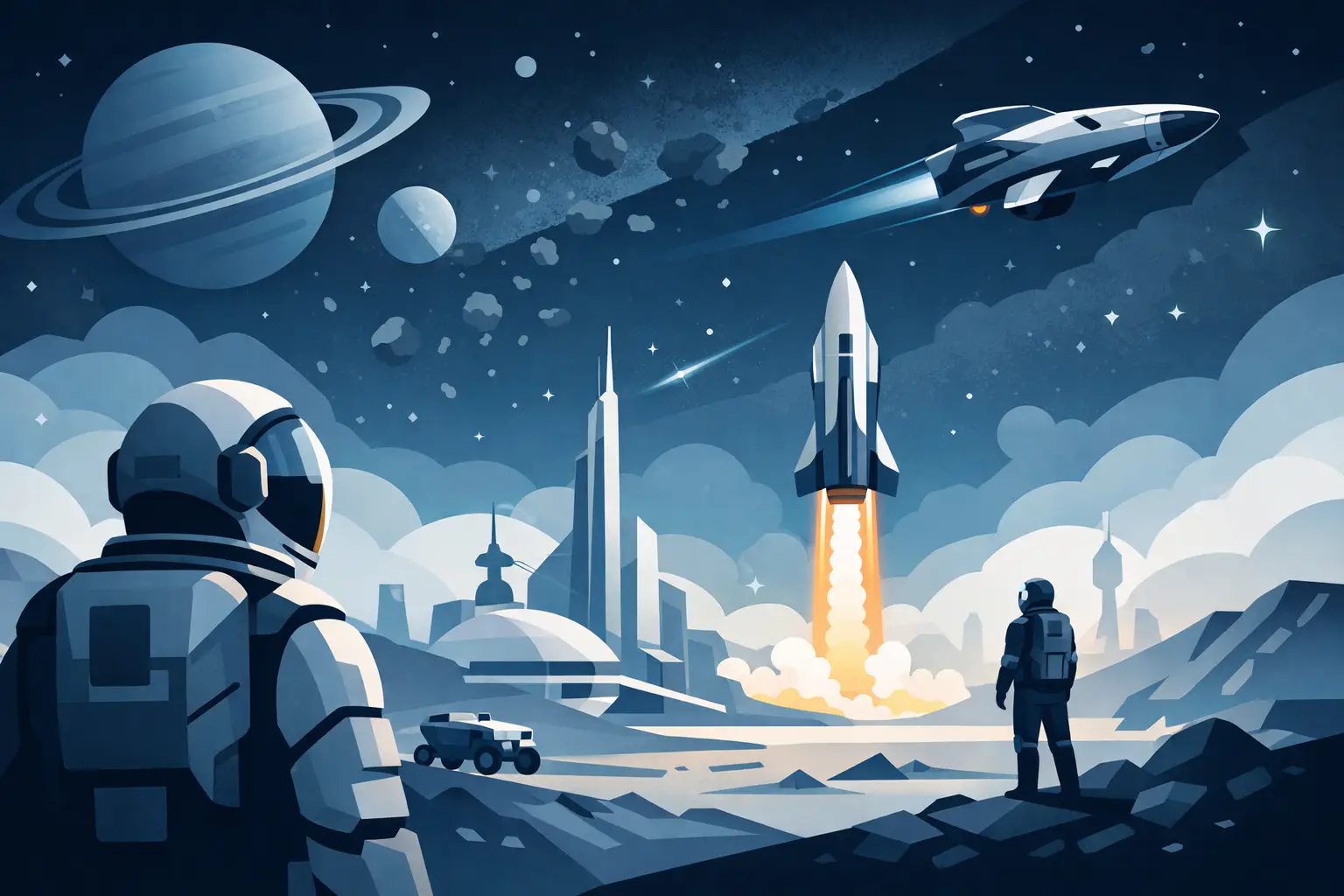
A starship crossing interstellar dark is no longer enough. For readers who love hard science fiction, spectacle has to carry weight. The future of hard science fiction will be decided not by bigger explosions or louder apocalypses, but by whether the genre can keep doing what it does best: take the most demanding ideas in science and force them through the furnace of human consequence.
That pressure is already changing the field. Readers are more scientifically literate than they were a generation ago. They have lived through breakthroughs in AI, private spaceflight, gene editing, climate modeling, and quantum theory entering mainstream conversation. They are not satisfied with science as wallpaper. They want stories where physics matters, where time is dangerous, where distance reshapes love and duty, and where a breakthrough is never just a clever plot device. It is a moral event.
Why the future of hard science fiction feels different
Classic hard science fiction often built its grandeur from engineering, astronomy, and systems thinking. That foundation still matters. Orbital mechanics still matter. Energy budgets still matter. Cause and effect still matter. But the genre is moving beyond the old assumption that rigor alone creates power.
The next era will ask more from itself. It will need scientific discipline and emotional intelligence. It will need wonder without hand-waving. It will need to confront the fact that every major scientific leap creates not just possibility, but distortion. New knowledge changes institutions. It changes war. It changes intimacy. It changes what a person owes to a species, a timeline, or a world that may not survive first contact with truth.
That shift is good news for serious readers. It means hard science fiction is becoming less mechanical and more volatile. The equations remain, but now they sit closer to grief, obsession, sacrifice, and ethical fracture. The result is a genre with more reach, not less.
The science will get harder – and stranger
One clear feature of the future of hard science fiction is that its scientific backbone will keep expanding. Earlier generations leaned heavily on rockets, computers, and planetary exploration. Tomorrow’s stories have a broader frontier. Quantum information, non-human cognition, synthetic biology, planetary engineering, causality problems, and machine-assisted discovery are no longer fringe material.
That does not mean every novel needs to read like a graduate seminar. It means the genre has richer raw material than ever before. A writer can ask what happens when consciousness is mapped but not understood. Or when a wormhole is possible in principle but catastrophic in practice. Or when parallel timelines stop being a thought experiment and become a test of moral identity.
The best hard science fiction will not merely mention these ideas. It will build worlds where those ideas exert pressure. Scientific plausibility is not a box to check. It is the gravity field of the story.
There is also a trade-off here. As concepts become more abstract, stories risk becoming cold or inaccessible. Not every reader wants pages of technical exposition, and not every idea benefits from being overexplained. The strongest work will know when to clarify and when to trust the reader. Precision matters, but mystery still has power.
Human stakes are becoming the real battleground
Hard science fiction has sometimes carried an unfair stereotype: brilliant ideas, thin people. That stereotype was never entirely true, but the genre’s future will bury it if writers are willing to push further into character without softening the science.
Readers want consequences that feel lived in. What does relativistic travel do to memory and loyalty? What happens to a marriage when causality itself becomes unstable? How does a scientist live with discovery when that discovery can erase cities, rewrite history, or reveal that humanity is not the only intelligence shaping reality?
These are not decorative questions. They are central to where the genre is headed. The farther science reaches, the more severe the human cost of knowing becomes. That is where hard science fiction becomes unforgettable – at the intersection of time, space, and humanity, where a technical problem becomes a wound, a temptation, or a destiny.
This is especially true for stories involving time travel, alien intelligence, or colonization. Readers no longer want these elements presented as simple adventure machinery. They want their destabilizing force. A colony on Mars is not just a triumph of engineering. It is a test of governance, psychology, scarcity, and what kind of civilization survives when Earth is no longer the unquestioned center. First contact is not just a thrilling reveal. It is a collision between minds that may not share language, morality, embodiment, or any familiar logic of survival.
Hard science fiction is absorbing philosophy again
One of the most exciting developments in the genre is its renewed comfort with philosophical scale. Hard science fiction is uniquely suited to explore questions most literature can only circle from a distance. What counts as identity across timelines? Is consciousness transferable, or only imitated? Does humanity have the right to reshape another planet before it fully understands its own violence? If a future self manipulates the present, is that wisdom or tyranny?
These questions are not abstractions for this genre. They are plot engines. They generate suspense because they generate irreversible choices.
This philosophical return matters because modern readers are not only looking for prediction. They are looking for confrontation. They want fiction that does not merely speculate about technology, but dares to ask what kind of species builds it. The future of hard science fiction belongs to stories that understand this. Not stories that preach, but stories that place characters in situations where every answer costs something.
That is part of why concept-driven fiction still has such force. When it is done well, the big idea does not sit above the story like a lecture. It burns through every scene. It changes what love means. It changes what survival means. It changes whether hope is rational or rebellious.
Readers are asking for scale with discipline
Modern genre audiences have almost endless access to science fiction across film, television, games, and streaming spectacle. That makes discipline more valuable, not less. Readers can find visual excess anywhere. What they come to hard science fiction for is coherence. They want the vastness of cosmic possibility, but they also want systems that hold together under scrutiny.
That creates a higher bar for writers. A future setting must feel imagined and reasoned. A technology must alter society in recognizable ways. A mission into deep space must account for isolation, communication lag, biological strain, and political pressure. The genre’s authority comes from this seriousness.
Still, discipline should not be confused with narrowness. Hard science fiction can be wild. It can be emotionally ferocious, structurally ambitious, even reality-bending. It simply cannot cheat. If it asks the reader to believe in extraordinary things, it must earn that belief through internal logic and intellectual honesty.
That balance is where the genre feels most alive right now. Not trapped in textbook realism, and not floating into fantasy with a lab coat. Grounded, but audacious.
What writers will need to do next
The future of hard science fiction will favor writers who can unite three forces at once: scientific credibility, narrative urgency, and philosophical nerve. Lose one of those, and the story narrows.
Scientific credibility without urgency can feel bloodless. Urgency without credibility turns generic. Philosophy without story becomes essay disguised as fiction. But when all three lock together, the result is the kind of novel readers remember for years – the kind that makes them stare at the ceiling after the final page and reconsider what time, consciousness, or civilization might really mean.
This is why hard science fiction still matters so deeply. It is one of the few literary spaces where the largest imaginable questions can be tested under pressure. Not in the abstract, but in the lives of people forced to choose under conditions no previous generation has faced.
Authors working in this tradition have an unusual opportunity. They can write beyond trend. They can build stories that do not just mirror current anxieties, but anticipate the next set of human collisions with knowledge. In that sense, the genre’s future is not smaller or more niche. It is sharper. More demanding. More willing to ask whether discovery is salvation, catastrophe, or both.
For readers drawn to bold speculative fiction with real scientific gravity, that is a thrilling prospect. It means the coming era will not belong to stories that merely visit the stars. It will belong to stories that understand what the stars, the equations, the timelines, and the unknown are capable of taking from us – and what they might reveal when we go anyway. Writers like J. Thomas Hunton are already working in that charged territory, where scientific imagination meets the full human cost of wonder.
The next great hard science fiction story will not just predict tomorrow. It will make tomorrow feel morally immediate, intellectually dangerous, and impossible to ignore.