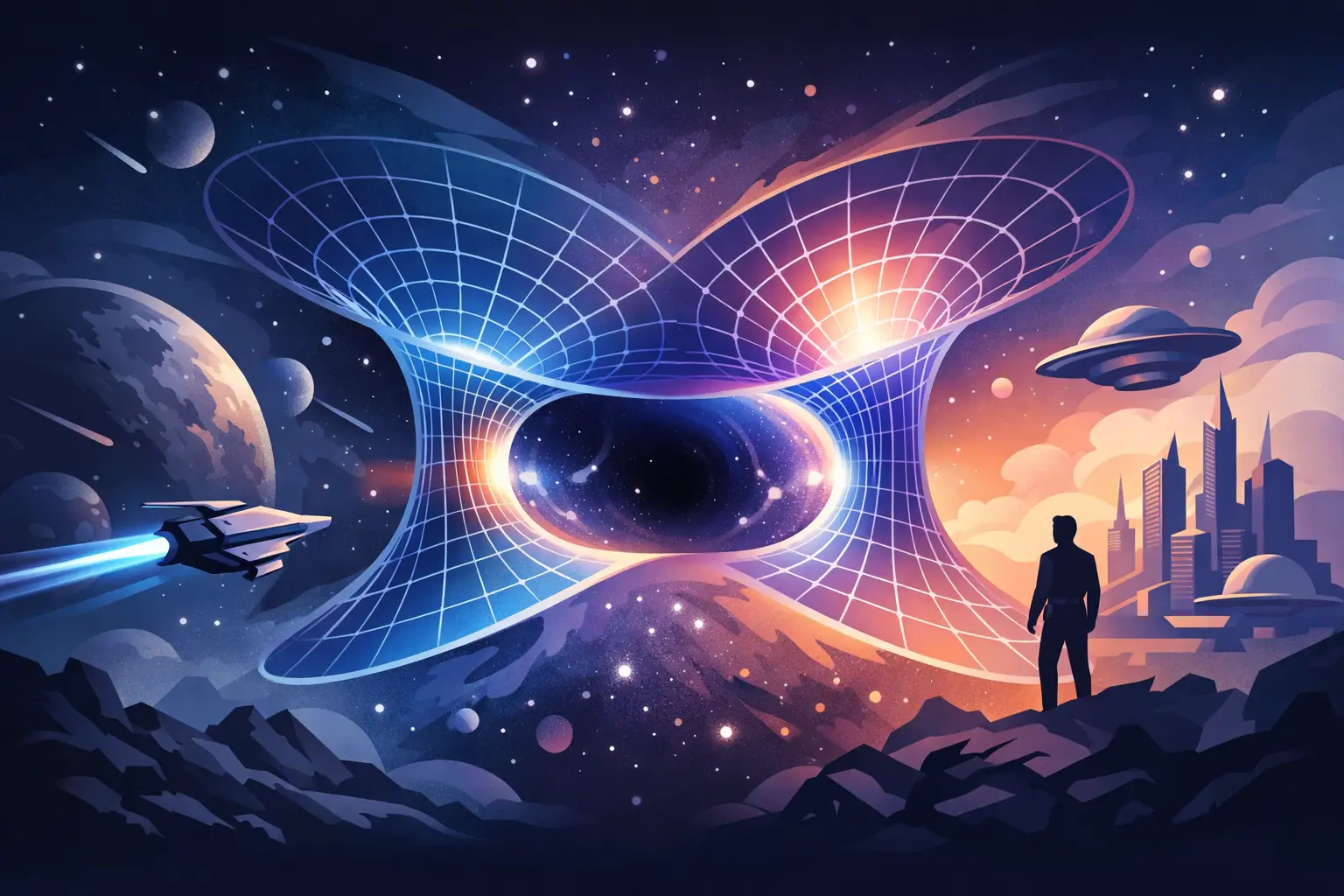
A starship vanishes at the edge of known space, slips through a wound in spacetime, and emerges somewhere impossible – another galaxy, another century, another version of history. That image endures because it captures exactly how wormholes shape sci fi: not as a flashy shortcut, but as a narrative force that bends distance, causality, and human identity into new forms.
Wormholes sit at the fault line between hard science and mythic possibility. They let writers ask a question that ordinary propulsion cannot answer fast enough: what happens to people when the universe stops obeying familiar limits? For serious science fiction, that is where the real power begins. A wormhole is never just a tunnel. It is a test of what characters believe about time, home, responsibility, and survival.
How wormholes shape sci fi at the story level
The most obvious effect is scale. Interstellar fiction has a basic problem: space is vast beyond human instinct. Even with advanced engines, realistic travel times can crush momentum or push a story into generations-long timelines. Wormholes change that equation. They make the galaxy dramatically accessible while preserving a sense of cosmic danger.
That matters because accessibility is not the same as simplicity. A wormhole can connect two distant points, but it also creates asymmetry. Who controls the entrance? Is passage stable? Can information cross as easily as matter? Does one side experience time differently? The moment a writer asks those questions, the wormhole stops being a convenience and becomes infrastructure, territory, and potential weapon.
In strong science fiction, this is where the concept earns its place. A wormhole is most compelling when it creates consequences rather than erasing obstacles. If travel becomes too easy, a story shrinks. If travel remains unpredictable, contested, or costly, the story gains pressure.
The physics gives the trope weight
Part of the fascination comes from the fact that wormholes are not pure fantasy. They emerge from solutions and implications within general relativity, even if traversable wormholes remain speculative and loaded with impossible-seeming requirements. That brush with real physics gives the idea a special authority.
Readers of hard science fiction do not need a textbook in the middle of a novel, but they can feel the difference between a concept grounded in scientific tension and one used as decorative magic. Wormholes suggest curved spacetime, extreme gravity, exotic matter, and energy demands that border on absurd. Those details matter because they frame the stakes. If holding a wormhole open requires civilization-scale engineering or dangerous unknown materials, then every transit carries political and ethical weight.
This is one reason the trope survives. It allows fiction to remain intellectually serious while still reaching for the operatic. You get equations in the walls, but also awe. You get the cold logic of spacetime geometry, then watch that logic collide with fear, ambition, and grief.
Not all wormholes serve the same kind of story
Some stories use wormholes as stable corridors, almost like maritime trade routes in space. That approach supports empire, commerce, colonization, and military tension. Whoever governs the gates governs movement itself. The drama becomes strategic.
Other stories treat wormholes as unstable anomalies. In those versions, crossing one is closer to an act of faith. Navigation may be uncertain. Return may be impossible. The drama becomes existential.
A third version pushes beyond travel and into temporal distortion. If a wormhole links not just separate places but separate times, then sci-fi enters more dangerous territory. Cause and effect begin to fray. Memory becomes suspect. Destiny starts to look like a trap.
Wormholes are engines of moral conflict
This is the point weaker sci-fi often misses. A wormhole does not matter because it moves ships quickly. It matters because it changes the moral geometry of a civilization.
If a colony can be reached in hours instead of decades, abandonment becomes a choice rather than a technical inevitability. If a military can strike across impossible distance, deterrence changes. If refugees can escape a dying world through a narrowing corridor, then every decision at the threshold becomes brutally human. Who goes first? Who is left behind? Who gets to define necessity?
That is how wormholes shape sci fi in its deepest form. They force characters to confront scale without losing intimacy. The universe grows larger, but each decision becomes sharper. One opened passage can redraw the meaning of loyalty, nationhood, family, and species identity.
For readers who want more than spectacle, this is where the concept becomes unforgettable. The best wormhole fiction asks whether humanity expands its wisdom along with its reach. Often, the answer is troubling.
Why wormholes pair so well with time travel and parallel realities
Wormholes are especially powerful in stories that already engage time travel, branching timelines, or layered realities. The reason is simple: once spacetime becomes navigable, chronology no longer feels fixed. Past and future stop behaving like a straight road. They start acting like terrain.
That shift opens extraordinary possibilities, but it also raises the standard. A writer cannot simply scatter paradoxes across the page and expect readers to stay invested. The internal logic has to hold. If a wormhole alters timing by minutes, years, or entire eras, the story needs to understand the cost of that distortion.
Used well, this creates rare dramatic force. A character might arrive before the signal that sent them. A rescue mission might trigger the disaster it meant to prevent. Two people may step through the same aperture and emerge into different histories. These are not gimmicks when they are tied to choice. They are instruments for examining regret, fate, and responsibility under impossible conditions.
That territory is central to concept-driven science fiction. It turns the mechanics of spacetime into pressure on the soul.
The trade-off between wonder and credibility
There is always a balancing act with wormholes. Push too far toward mystery, and the concept can feel arbitrary. Push too far toward exposition, and the story can become airless. The strongest sci-fi finds the narrow band where explanation deepens wonder instead of smothering it.
This is especially true for readers who care about scientific imagination. They do not expect certainty from speculative fiction. They do expect rigor of thought. A wormhole can be impossible by current standards and still feel convincing if the world around it respects consequence.
That means limitations matter. Maybe the passage erodes biological tissue. Maybe only information can cross safely. Maybe one transit shifts local time enough to fracture relationships back home. Constraints are not creative penalties. They are what turn a grand idea into story.
In that sense, wormholes resemble any powerful technology in fiction. Their meaning comes from boundaries. Infinite capability kills suspense. Conditional capability creates drama.
Why the image still grips us
There is a primal quality to the wormhole image that goes beyond physics. It promises breach. A sealed universe suddenly opens. A frontier once measured in lifetimes folds inward. Human beings, who evolved under one sky on one world, find a way to step outside the prison of ordinary distance.
That promise is thrilling, but also unsettling. Every portal implies trespass. If we can reach farther than we were meant to, what waits on the other side? Discovery in serious sci-fi is never innocent for long. It brings contamination, misunderstanding, conquest, revelation. Wormholes intensify all of it because they remove the buffer of time. Contact becomes immediate. So does consequence.
This is why the trope remains alive across generations of science fiction. It speaks to the oldest dream in the genre – that knowledge can break barriers – while preserving the oldest warning: breaking barriers changes the breaker.
For readers drawn to fiction at the intersection of time, space, and humanity, wormholes offer more than momentum. They create the conditions for stories where science is not wallpaper and wonder is not empty decoration. They let writers build worlds big enough for cosmic speculation and tight enough for personal reckoning. In work that values both intellectual ambition and emotional consequence, including fiction such as that found in J. Thomas Hunton’s orbit, that combination is hard to resist.
The next time a ship disappears into a bright rupture in the dark, the real question is not where it will emerge. The real question is what kind of truth the passage will force it to face.
3 Responses
https://shorturl.fm/4wMOX