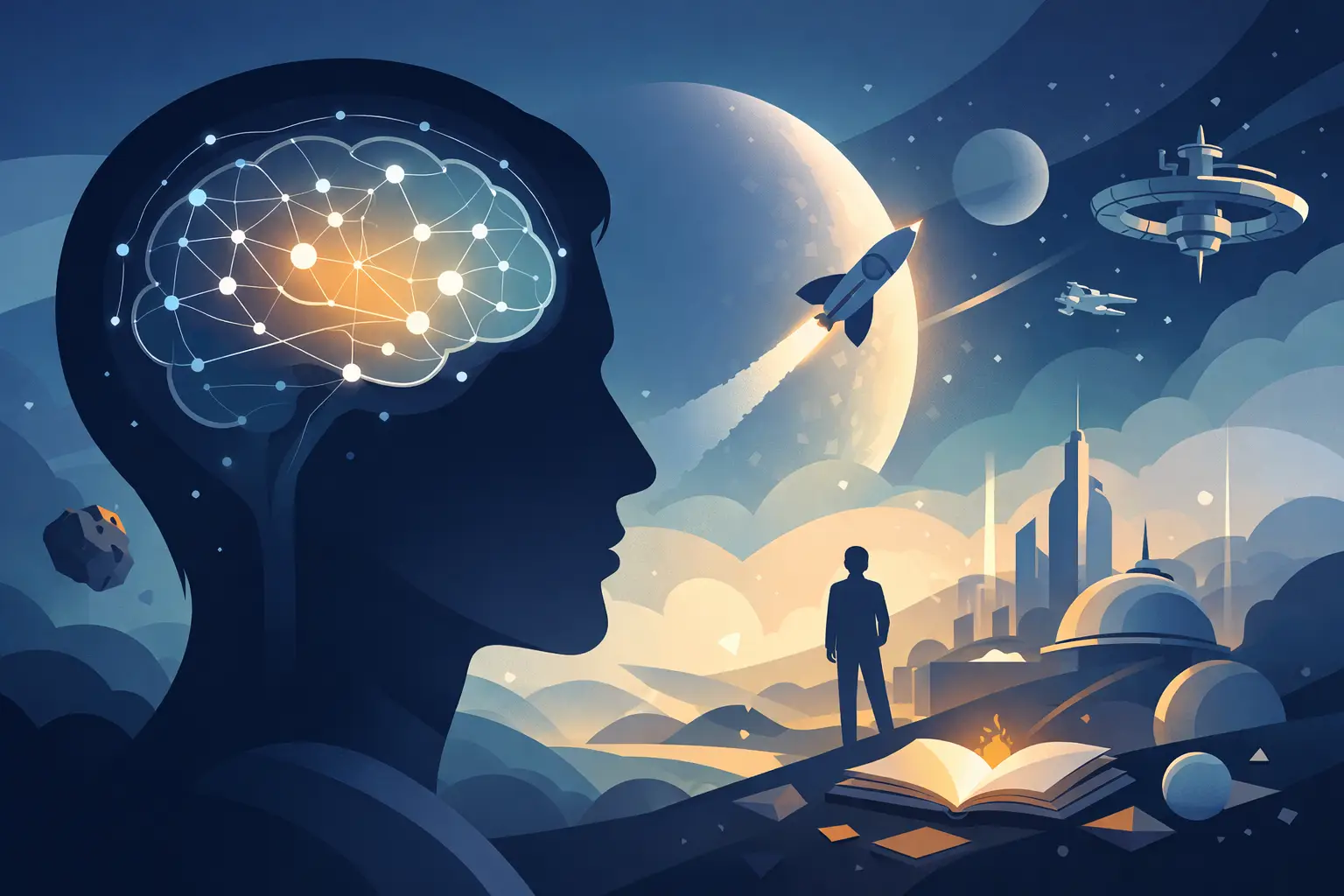
A ship can cross a star system, a machine can fracture time, an alien signal can rewrite everything humanity thinks it knows – and none of that matters if the story has nothing real to say about being human. That is where cerebral sci fi separates itself from spectacle. It does not use science as decoration. It uses science to apply pressure to identity, ethics, memory, survival, and destiny.
For readers who want more than chases, firefights, and clean victories, this corner of science fiction offers something rarer. It asks harder questions and refuses easy answers. The reward is not just excitement, but the unsettling thrill of feeling your worldview shift a few degrees by the final page.
What cerebral sci fi really means
Cerebral sci fi is often described as idea-driven science fiction, but that definition is too thin. Plenty of stories have big ideas. What makes a work genuinely cerebral is the way it forces concept and consequence into collision. The technology, physics, or speculative premise cannot simply be impressive. It has to challenge the characters at the deepest level and place the reader in direct contact with uncertainty.
A time travel story becomes cerebral when it stops being a puzzle box and starts asking whether changing the past is an act of mercy, arrogance, or violence. A first-contact novel becomes cerebral when the alien intelligence is not merely strange, but so fundamentally different that human language, morality, and perception begin to fail under the strain. A Mars colonization story enters this territory when survival is not the only issue – when isolation, governance, sacrifice, and the meaning of a future human civilization become central to the conflict.
In other words, cerebral science fiction does not just imagine the impossible. It interrogates the implications.
The core engine of cerebral sci fi
At its best, cerebral sci fi runs on tension between wonder and discipline. It wants the cosmic scale of speculation, but it also wants internal rigor. Readers drawn to this kind of fiction usually do not want arbitrary twists disguised as profundity. They want a story that respects causality, thinks through consequences, and understands that a bold premise becomes more powerful when it is grounded.
That grounding can come from hard science, from philosophical consistency, or from psychological realism. Ideally, it comes from all three. The exact balance depends on the novel. Some stories lean heavily into advanced physics and let the emotional stakes rise from the science itself. Others begin with human fracture – grief, obsession, guilt, ambition – and use speculative elements to expose what the characters cannot hide from themselves.
This is why the genre can feel so intense even when very little explodes. The pressure is internal as much as external. A paradox, a discovery, or a transmission can carry the force of a battle if it threatens a character’s sense of truth.
Big ideas are only half the equation
There is a trap in talking about cerebral fiction. People sometimes assume it means cold fiction, or stories more interested in equations than emotion. The best examples prove the opposite. Intelligence alone does not make a novel memorable. It is the fusion of intellect and emotional cost that gives these stories their charge.
If a scientist discovers evidence of parallel timelines, the concept matters. But what matters more is what follows. Does she try to save one world by sacrificing another? Does the existence of alternate selves deepen her compassion, or erase her certainty that any choice has meaning? Once a story crosses into that territory, it becomes more than concept-first fiction. It becomes intimate and destabilizing at the same time.
Why serious readers keep coming back to it
Readers who love cerebral sci fi are often looking for a specific kind of experience. They want awe, but they also want resistance. They want a novel that trusts them to think, to infer, to wrestle with ambiguity instead of receiving every answer in a neat package.
That trust matters. It creates a different relationship between story and reader. Instead of passive entertainment, the book becomes an active encounter. You are not just following events. You are interpreting systems, weighing ethical trade-offs, and testing your own assumptions against a speculative world that feels disturbingly plausible.
This is especially true in stories built around time distortion, alien consciousness, or civilization-scale decisions. Those premises naturally produce difficult moral terrain. Should humanity expand into space if expansion reproduces the same violence and hierarchy it claims to escape? If communication with a nonhuman intelligence changes our understanding of reality, is that enlightenment or annihilation? If a machine can model the future with terrifying accuracy, what happens to freedom?
Cerebral science fiction thrives because it takes these questions seriously.
Cerebral sci fi and hard science fiction
The two are related, but they are not identical. Hard science fiction is usually defined by close attention to scientific plausibility. Cerebral sci fi is defined more by intellectual and philosophical weight. Many stories are both, and that overlap is where some of the most compelling work in the genre lives.
Still, one does not guarantee the other. A novel can be scientifically meticulous and emotionally flat. Another can be philosophically rich while taking looser liberties with scientific detail. For readers who crave the strongest version of the form, the sweet spot is where scientific imagination and human consequence are inseparable.
That is one reason hard sci-fi readers often gravitate toward fiction involving wormholes, relativistic travel, deep space missions, and timeline fractures. These ideas are inherently dramatic, but they also invite precision. If the author treats them seriously, the result can feel immense. The story does not merely entertain. It suggests that the universe has laws, and that human beings will pay a price for trying to bend them.
Where the trade-offs show up
There is always a balancing act. Too much exposition and the story stiffens. Too little and the premise loses authority. Too much abstraction and the emotional core fades. Too much focus on action and the intellectual architecture collapses into backdrop.
The strongest cerebral fiction understands pacing as modulation, not speed. It knows when to pause for a disturbing implication, when to let silence carry dread, and when to accelerate because an idea has finally become personal.
The themes that define the genre
Certain themes recur because they expose the fault lines between knowledge and power. Time travel remains one of the most potent because it transforms regret into a mechanism. Space exploration endures because distance magnifies both human courage and human fragility. Alien intelligence matters because it forces humanity out of its narcissism. Parallel timelines matter because they turn choice into a haunting landscape of unrealized lives.
But the theme beneath all of them is consequence. Cerebral sci fi asks what discovery costs. Not just in fuel, blood, or infrastructure, but in identity. A civilization that learns it is not alone is no longer the civilization it was before. A person who sees multiple versions of reality cannot return untouched to a simpler idea of self.
That is the hidden power of the genre. It makes revelation feel dangerous.
Why this kind of story feels urgent now
The appeal of cerebral science fiction is not limited to genre tradition. It speaks directly to a culture already grappling with runaway technology, unstable truth, predictive systems, climate risk, and the uncomfortable speed of scientific change. We live close enough to transformation that speculative fiction no longer feels safely distant.
That proximity raises the stakes. Stories about artificial intelligence, planetary migration, surveillance, or altered time are not just imaginative exercises anymore. They are rehearsal spaces for moral thought. They let readers test responses to futures that seem less impossible every year.
This is why the genre can feel so electric. It captures the thrill of breakthrough while refusing to look away from the damage breakthrough can do. Wonder remains essential, but wonder alone is not enough. The most memorable stories understand that every frontier creates a new version of fear.
For writers like J. Thomas Hunton, working at the intersection of time, space, and humanity, that tension is the point. The science opens the door. The human cost is what makes stepping through it unforgettable.
What to look for in great cerebral sci fi
The best novels in this space leave you with more than admiration for the premise. They leave a residue. A moral question that keeps resurfacing. A scientific possibility that now feels disturbingly real. A character choice that seemed impossible until the story made it feel inevitable.
Look for fiction that respects complexity without becoming obscure for its own sake. Look for stories where the speculative framework changes the emotional equation, not just the scenery. Look for authors unafraid to let ideas remain dangerous.
Because that is the promise of cerebral sci fi. It does not merely show you another world. It alters your sense of this one, then leaves you in the aftershock – a little more curious, a little less certain, and far more awake to the vast, unforgiving possibilities ahead.